



Why Your Business Can’t Afford to Ignore Data Protection
Business data protection is the process of safeguarding sensitive information from unauthorized access, theft, or loss through a combination of technical, physical, and administrative safeguards. For small and medium-sized businesses, effective data protection involves:
- Identifying and inventorying all personal and sensitive data your business collects and stores
- Implementing security measures like encryption, access controls, and regular backups
- Training employees to recognize threats and follow data handling protocols
- Complying with regulations such as GDPR, CCPA, HIPAA, and the FTC Safeguards Rule
- Preparing an incident response plan to detect, report, and recover from data breaches
What would happen if your business lost all its data tomorrow? According to FEMA, 40% of small businesses never reopen after a disaster, and an additional 25% shut down within one year. That’s a 65% total failure rate for unprepared businesses.
The stakes have never been higher. The global average cost of a data breach hit $4.45 million in 2023—a 15% increase over three years. And it’s not just large corporations at risk. In 2013, Target Corporation faced one of the largest retail data breaches in history when hackers accessed their network through a third-party vendor, impacting 40 million credit and debit card accounts. The breach cost Target over $200 million in legal fees, settlements, and remediation.
The good news? Most effective data protection measures don’t require massive budgets. Simple steps like using strong passwords, locking up sensitive paperwork, and training your staff cost next to nothing but can prevent devastating losses.
I’m Paul Nebb, founder of Titan Technologies, and I’ve spent over 15 years helping businesses across the United States protect their data and comply with evolving regulations like GDPR and HIPAA. Business data protection isn’t just about technology—it’s about building a culture of security that protects your customers, your reputation, and your bottom line.
Find more about Business data protection:
Why Business Data Protection is Your Most Valuable Asset
In today’s digital economy, data is often described as the “new oil.” It fuels your marketing, streamlines your operations, and helps you understand your customers. However, unlike oil, if your data leaks, it doesn’t just cause a mess—it can end your business.
Beyond the immediate financial sting, a data breach causes profound reputational damage. Trust takes years to build and only seconds to lose. When customers hear that their private information was exposed, they don’t just get angry; they leave. In fact, The Average Data Breach Now Costs $4.88 Million, a figure that includes lost business, legal fees, and the high cost of notifying affected individuals.
Business continuity is another critical factor. FEMA disaster statistics show that without a plan, most small businesses simply cannot weather a catastrophic data loss event. Conversely, a robust Business data protection strategy provides a competitive advantage. It tells your clients, “We value you, and we are professional enough to keep your secrets safe.”
Identifying PII for Business Data Protection
To protect your data, you first have to know what you have. The most sensitive category is Personally Identifiable Information (PII). This is any data that can be used to distinguish or trace an individual’s identity.
Research from Harvard shows that 87% of people in the United States can be uniquely identified using just three pieces of information: date of birth, gender, and ZIP code. When you add more specific data points like Social Security numbers, bank account details, or biometric data, the risk skyrockets. Understanding the Risks of Data Breaches in Financial and Medical Practices is vital, as these industries handle the most “identifiable” and sensitive data imaginable.
The Cost of Non-Compliance
If the threat of hackers isn’t enough to motivate you, the government certainly will. Regulatory bodies have become increasingly aggressive. In May 2023, Ireland’s data protection authority slapped Meta with a staggering $1.3 billion fine for GDPR violations.
Closer to home, the Target breach consequences serve as a warning for local businesses in New Jersey. Between legal settlements and remediation, the costs far exceeded the initial price of implementing better security. Non-compliance leads to a “death by a thousand cuts”: regulatory fines, legal settlements, and massive customer churn.
The Core Pillars of Business Data Protection

A sound Business data protection plan is built on a few fundamental principles. We recommend following the NIST Cybersecurity Framework, which provides a gold standard for identifying, protecting, detecting, responding to, and recovering from threats.
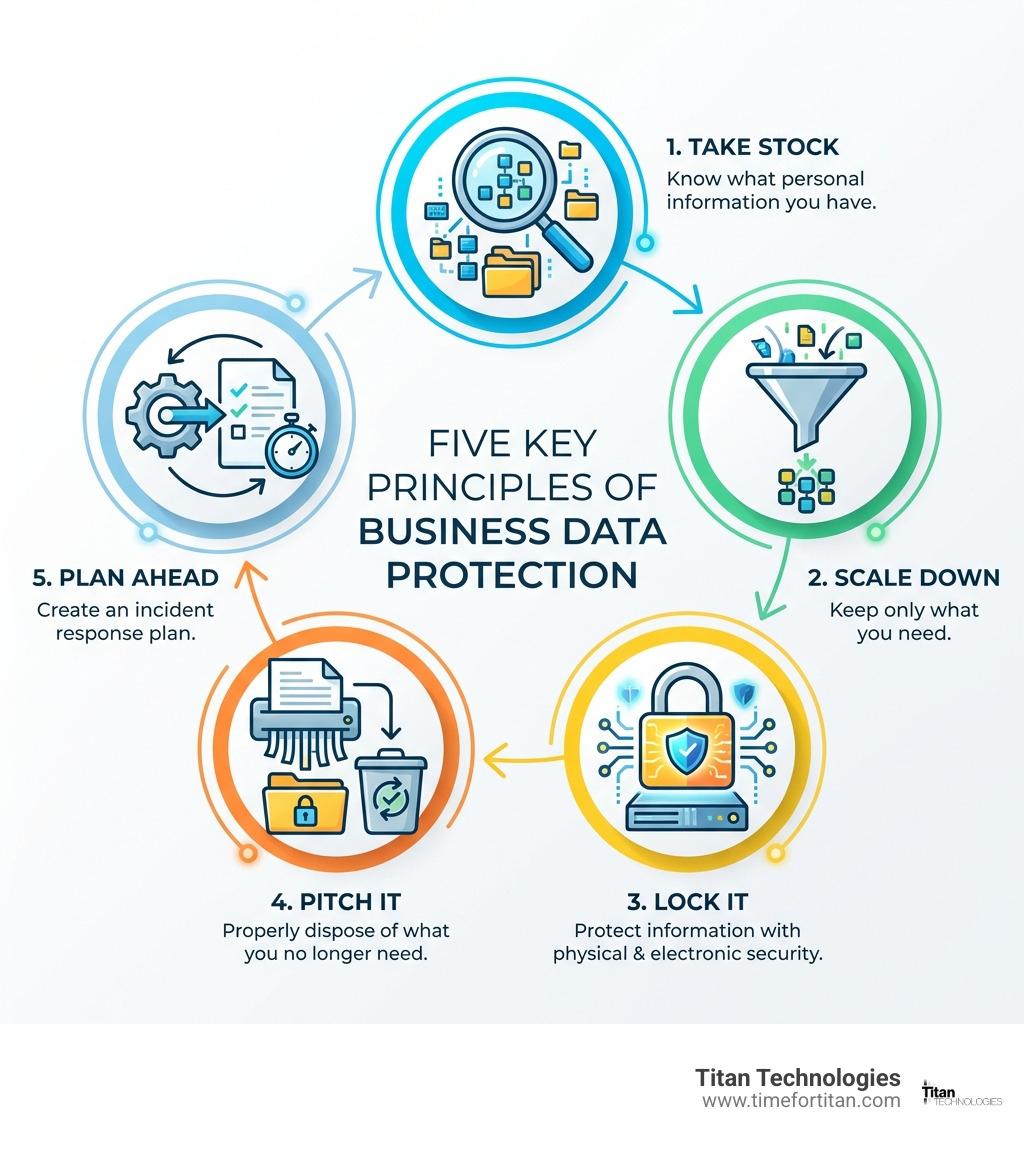
First, you must “Take Stock.” You cannot protect what you don’t know you have. This means inventorying every laptop, server, mobile device, and even digital copier in your office. Yes, digital copiers have hard drives that store every document scanned or copied! Once you have an inventory, you can develop a comprehensive Data Protection Plan.
Strategies for Data Minimization
The second pillar is “Scale Down.” If you don’t have it, they can’t steal it. Many businesses keep “zombie data”—files from customers they haven’t seen in a decade.
We advocate for strict Data Protection Governance, Risk Management, and Compliance policies. This includes:
- Collection Limits: Only ask for the information you actually need to complete a transaction.
- Retention Policies: Set an expiration date for data. Once the business need is over, it’s time to dispose of it.
- De-identification: If you need data for analytics, remove the PII so the data points can no longer be linked to specific individuals.
Securing Third-Party Relationships
The Target vendor exploit proved that your security is only as strong as your weakest contractor. Hackers didn’t break into Target directly; they stole credentials from an HVAC contractor.
Every business must audit the security practices of its service providers. Ensure your contracts include specific data protection requirements and that you share only the minimum amount of data necessary for them to do their jobs. Managing supply chain risk is no longer optional; it’s a core part of modern business.
Navigating Legal Obligations and Privacy Regulations
The legal landscape for Business data protection is a bit of a “alphabet soup”—GDPR, CCPA, HIPAA, and more. While it feels overwhelming, these laws generally share the same goal: giving individuals control over their information.
- GDPR: If you do business with anyone in the EU, this applies to you. It emphasizes “lawfulness, fairness, and transparency.”
- CCPA/CPRA: These California laws apply to many businesses that generate over $25 million in revenue or handle the data of 100,000+ households. Even if you are based in Trenton or Princeton, if you have California customers, you must comply.
- FTC Safeguards Rule: This rule requires financial institutions—which the FTC defines broadly to include auto dealerships and check cashers—to have a written information security program.
Missing these requirements is The Compliance Blind Spot Costing Small Businesses Thousands.
Ethical Data Handling
Beyond the law, there is an ethical obligation. Harvard research on re-identification highlights how easy it is to accidentally expose people. Responsible innovation means being transparent about how you use data. When you collect information, tell people who you are and how you’ll use it. Consent isn’t just a checkbox; it’s the foundation of consumer trust.
Industry-Specific Requirements
Different sectors face different problems. Data Protection for Financial Services focuses heavily on the FTC Safeguards and preventing identity theft. Healthcare providers, meanwhile, must steer the strict privacy and security rules of HIPAA to protect patient records. Whether you’re in pharma or retail, your data strategy must be custom to your specific regulatory environment.
Implementing Physical and Electronic Security Measures
Security isn’t just about firewalls; it’s about locks and keys, too. Physical security involves keeping sensitive paperwork in locked cabinets and ensuring that only authorized personnel can enter server rooms.
On the digital side, we look to the SANS Top 20 Controls for guidance. One of the most critical—and often overlooked—steps is patch management. The Equifax unpatched software lesson is a painful one: 147 million people had their data exposed because of a single piece of software that wasn’t updated. At Titan Technologies, we ensure our clients’ Network Security is always current with the latest vendor-approved patches.
Electronic Safeguards for Business Data Protection
To truly “Lock It,” you need a multi-layered electronic defense:
- Encryption: Encrypt data at rest (on your hard drives) and in transit (while being emailed or uploaded). Our Email Services, Encryption, Archiving solutions are designed to make this seamless for your team.
- Multi-Factor Authentication (MFA): This is the single most effective way to stop unauthorized access. Even if a hacker steals a password, they can’t get in without that second code on your phone.
- Firewalls: Think of these as the security guards of your digital perimeter.
The Human Element: Training and Access
Your employees are your first line of defense—or your greatest vulnerability. Most breaches happen because someone clicked a link they shouldn’t have. Regular training on phishing recognition is essential for good Cyber Hygiene.
We also recommend Role-Based Access Control (RBAC). This follows the “principle of least privilege”: an employee should only have access to the data they need to do their job. Your marketing intern probably doesn’t need access to the company payroll files!
Managing the Data Lifecycle and Incident Response
Data protection doesn’t end when you’re done with a file. “Pitch It” properly. When disposing of old files, shredding isn’t just for paper. You must use secure wiping software to clear hard drives before recycling computers or digital copiers.
Even with the best defenses, you must “Plan Ahead.” An incident response plan is your playbook for when things go wrong. We help businesses develop Business Disaster Recovery (BDR) strategies that include checking US-CERT vulnerability alerts regularly to stay ahead of new threats.
Preparing for Security Incidents
If a breach occurs, you don’t want to be figuring out who to call while your data is leaking onto the dark web. Your plan should include:
- A Response Team: Designate who is in charge of IT, legal, and communications.
- Detection Tools: Systems that alert you to unusual activity immediately.
- A Communication Strategy: How will you tell your customers and the authorities?
Using a Disaster Recovery Plan Example can help you visualize the steps needed to contain a threat and begin forensic analysis to understand what happened.
Post-Breach Obligations and Recovery
In many jurisdictions, the clock starts ticking the moment you find a breach. For example, under the UK’s ICO rules, you may need to report a breach within a 72-hour window.
Recovery is the final step. The Toy Story 2 backup lesson is a classic: Pixar nearly lost the entire movie due to a stray command, but an employee’s home backup saved a multi-million dollar project. A Cloud-Based Disaster Recovery Plan ensures that your “backup” is more than just a lucky break—it’s a guaranteed way to get back to work.
Frequently Asked Questions about Business Data Protection
What are the most common causes of business data loss?
While hackers get all the headlines, human error is the leading cause. This includes accidentally deleting files, losing unencrypted laptops, or falling for phishing scams. Other major threats include ransomware, hardware failure, and unpatched software vulnerabilities like the one that caused the Equifax breach.
How often should a business back up its data?
We recommend daily automated backups for all critical business data. However, a “set it and forget it” mentality is dangerous. You need a hybrid strategy—combining local backups for fast access with Cloud Backup Services NJ for disaster redundancy. Most importantly, you must perform regular recovery testing to ensure those backups actually work when you need them.
Does data protection law apply to small businesses?
Yes! While some laws like the CCPA have revenue thresholds ($25 million), others like GDPR apply to any business regardless of size if they handle EU citizen data. Furthermore, many small businesses in the UK must register with the ICO and pay a data protection fee (usually £52 per year). In the US, the FTC Safeguards Rule applies to many small businesses like auto dealers and mortgage brokers. Business data protection is a legal necessity for almost everyone.
Conclusion
Protecting your business data doesn’t have to be a source of constant anxiety. By following the five principles—Take Stock, Scale Down, Lock It, Pitch It, and Plan Ahead—you can build a resilient organization that is ready for anything.
At Titan Technologies, we specialize in taking the technical burden off your shoulders. We provide managed IT services and advanced cybersecurity solutions for businesses throughout Central New Jersey, including Edison, Elizabeth, Lakewood, Newark, Trenton, Princeton, New Brunswick, Matawan, Woodbridge, Freehold, and Red Bank. Our professional team offers fast, reliable support with a 100% satisfaction guarantee, ensuring your network is efficient and your data is secure.
Don’t wait for a disaster to realize the value of your data. Let us help you secure your future today.
Explore our Managed IT Services and Solutions to see how we can protect your business.