


A Practical Cybersecurity Framework for Accounting Firms That Want to Protect Their Clients, Reputation, and Business
CPA firms are trusted with some of the most sensitive information a person or business can provide. Tax returns, financial statements, payroll records, banking information, and confidential business documents all pass through the firm’s technology systems every day. Because of this responsibility, cybersecurity is no longer something that can be treated as an IT issue alone — it has become a fundamental part of protecting the firm’s reputation and maintaining client trust.
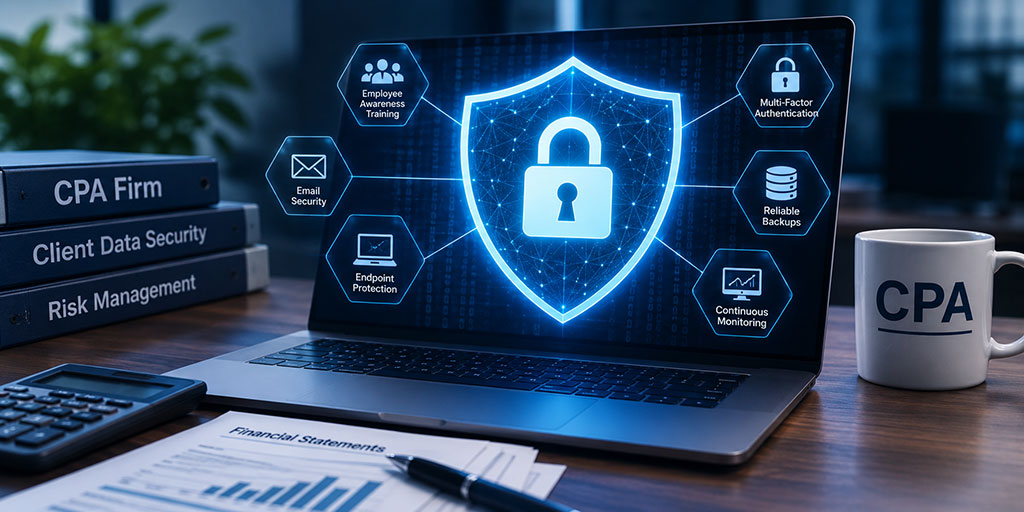
For most CPA firms with 5–50 employees, an effective cybersecurity strategy should include at least 7 core protections: identity security, multi-factor authentication, endpoint protection, email security, employee awareness training, reliable backups, and continuous monitoring. These protections work together to create multiple layers of defense because modern cyber threats rarely rely on a single point of failure.
The question is no longer whether a CPA firm is a target. The question is whether the firm has the right protections in place before an attack occurs.
The Reality of Cybersecurity for CPA Firms
Many accounting firms assume they are too small to be targeted by cybercriminals. Unfortunately, this assumption creates one of the biggest security risks facing smaller organizations today.
A CPA firm with 10, 25, or 50 employees can be an attractive target because it holds valuable information while often having fewer security resources than larger organizations. A compromised employee account, a successful phishing email, or a ransomware attack can interrupt operations at the exact moment when clients need the firm most.
Imagine a CPA firm entering the busiest weeks of tax season when employees suddenly cannot access important files, email systems are compromised, or client data is unavailable. The financial impact is obvious, but the reputational damage can be even greater. Clients trust their accountants to protect their information, and a security failure can quickly damage that confidence.
A proactive cybersecurity strategy helps prevent these situations by identifying risks before they become business disruptions.
The 7-Layer Cybersecurity Framework Every CPA Firm Should Consider
Cybersecurity works best when it is approached as a system rather than a single product. Installing antivirus software or having backups alone does not create a complete security strategy. CPA firms need multiple layers working together to reduce risk.
- Begin With a Cybersecurity Risk Assessment
The first step in improving security is understanding where vulnerabilities exist.
Many firms begin by purchasing security tools, but without first understanding their risks, they may spend money protecting the wrong areas while leaving important gaps exposed.
A cybersecurity assessment should answer questions such as:
Where is sensitive client information stored? Who has access to important systems? Are employees using secure authentication methods? Are backups reliable? Could the firm recover quickly after a ransomware event?
A strong assessment creates a roadmap. It allows a CPA firm to move from a reactive approach — waiting until something goes wrong — to a proactive strategy focused on reducing risk.
- Protect Employee Accounts With Strong Identity Security
One of the most common ways attackers gain access to business systems is through compromised user credentials.
For CPA firms, protecting employee accounts is especially important because one compromised login could expose confidential client information, email communications, and critical business systems.
Multi-factor authentication (MFA) is one of the most effective security improvements a firm can make. Instead of relying only on a password, MFA requires an additional verification step, creating another barrier for attackers.
A strong identity security approach also includes reviewing user permissions, removing unnecessary access, and ensuring employees only have access to the information they need to perform their jobs.
The goal is simple: make it significantly harder for unauthorized users to gain access.
- Secure Every Device That Connects to the Business
Every computer, laptop, and mobile device connected to a CPA firm’s environment represents a potential entry point for attackers.
Modern endpoint protection goes beyond traditional antivirus. A complete approach includes monitoring devices, keeping systems updated, identifying suspicious activity, and addressing vulnerabilities before they can be exploited.
This is especially important for CPA firms because employees often work with sensitive documents across multiple devices and locations. Whether someone is working from the office, remotely, or during an extended tax-season schedule, every device needs to meet the firm’s security standards.
- Strengthen Email Security and Reduce Phishing Risk
Email remains one of the most common methods attackers use to target businesses.
For CPA firms, this creates a significant challenge because email is central to daily operations. Firms communicate with clients, exchange documents, receive financial information, and coordinate important deadlines through email every day.
Cybercriminals take advantage of this by creating messages that appear legitimate. They may impersonate clients, vendors, or even employees in an attempt to steal information or gain access to accounts.
A strong email security strategy combines technology protections with employee awareness. Filtering tools, phishing protection, and regular security training work together to reduce the likelihood that a single email becomes a serious incident.
- Create a Backup and Recovery Strategy That Actually Works
Many businesses believe they are protected because they have backups. The problem is that not all backup strategies are created equal.
A backup is only valuable if the firm can successfully restore its information when it needs it.
A reliable recovery strategy follows the 3-2-1 backup approach:
- Maintain three copies of important data
- Store those copies in two different formats
- Keep one copy separated from the primary environment
For CPA firms, backup planning should also include testing. A firm needs to know not only that data is being backed up, but how quickly systems can be restored if an incident occurs.
The real question is not “Do we have backups?”
The real question is:
“How quickly can we get back to business if something goes wrong?”
- Train Employees to Become Part of the Security Solution
Technology alone cannot prevent every cyber threat.
Employees are often the first line of defense because they are the people receiving emails, accessing systems, and interacting with clients every day.
Security awareness training helps employees recognize suspicious activity, understand phishing attempts, and know what actions to take when something does not look right.
A strong security culture does not come from making employees afraid of technology. It comes from helping them understand their role in protecting the firm and their clients.
- Continuously Monitor and Improve Security
Cybersecurity is not a project that gets completed once.
Threats change constantly, new vulnerabilities are discovered, and technology environments continue to evolve. CPA firms need an ongoing process for monitoring, improving, and adapting their security strategy.
This includes regularly reviewing systems, addressing vulnerabilities, updating protections, and ensuring security practices continue to meet the needs of the business.
The strongest firms view cybersecurity as an ongoing investment in stability and trust.
How CPA Firms Should Evaluate a Cybersecurity Partner
Choosing the right IT provider is about more than finding someone who can fix technology problems.
A true cybersecurity partner should understand the unique challenges CPA firms face, including protecting confidential client information, maintaining productivity during deadlines, and reducing business risk.
When evaluating an IT provider, CPA firms should ask:
Does this provider understand accounting firms?
Do they have a proactive security process?
Can they explain how they protect client data?
Do they continuously monitor and improve security?
Can they demonstrate experience and results?
The answers to these questions often reveal the difference between a traditional IT vendor and a strategic technology partner.
Why CPA Firms Partner With Titan for Cybersecurity
Titan helps CPA firms create secure, reliable technology environments designed around the specific needs of accounting professionals.
For CPA firms with 5–50 employees, the right IT partner can provide more than technical support. It can provide confidence that systems are protected, employees can work efficiently, and client information is being handled responsibly.
Final Takeaway
Cybersecurity for CPA firms requires more than a single tool or quick fix. A strong security strategy combines 7 essential protections: risk assessment, identity security, device protection, email security, backups, employee training, and continuous monitoring.
CPA firms that invest in cybersecurity are not simply protecting computers — they are protecting client trust, business continuity, and the reputation they have built over years.
The right managed IT partner helps make cybersecurity a proactive advantage instead of a last-minute emergency.