




Why Network Management and Control Matters for Your Business
Network management and control is the set of processes, tools, and protocols that keep your business network running smoothly, securely, and efficiently. At its core, it means:
- Monitoring all devices and connections in real time
- Configuring routers, switches, and access points consistently
- Detecting and fixing problems before they disrupt operations
- Securing your network against threats and unauthorized access
- Planning for growth and changing business needs
In simple terms, network management is what you do to keep your network healthy, while network control is how you make decisions and enforce policies across all your devices.
Your network is the backbone of everything your business does today. Every email, video call, cloud application, and customer transaction depends on it. When your network slows down or fails, productivity stops. According to recent data, downtime costs Global 2000 companies an estimated $400 billion annually, averaging about $9,000 per minute. For small and mid-sized businesses in Central New Jersey, even an hour of downtime can mean lost revenue, frustrated customers, and scrambling employees.
The challenge has grown more complex. Your team now works from the office, from home, and on the road. You’re using more cloud services than ever. Cybercriminals can breach network perimeters and access local resources in 93% of businesses. Traditional firewalls and VPNs alone aren’t enough anymore.
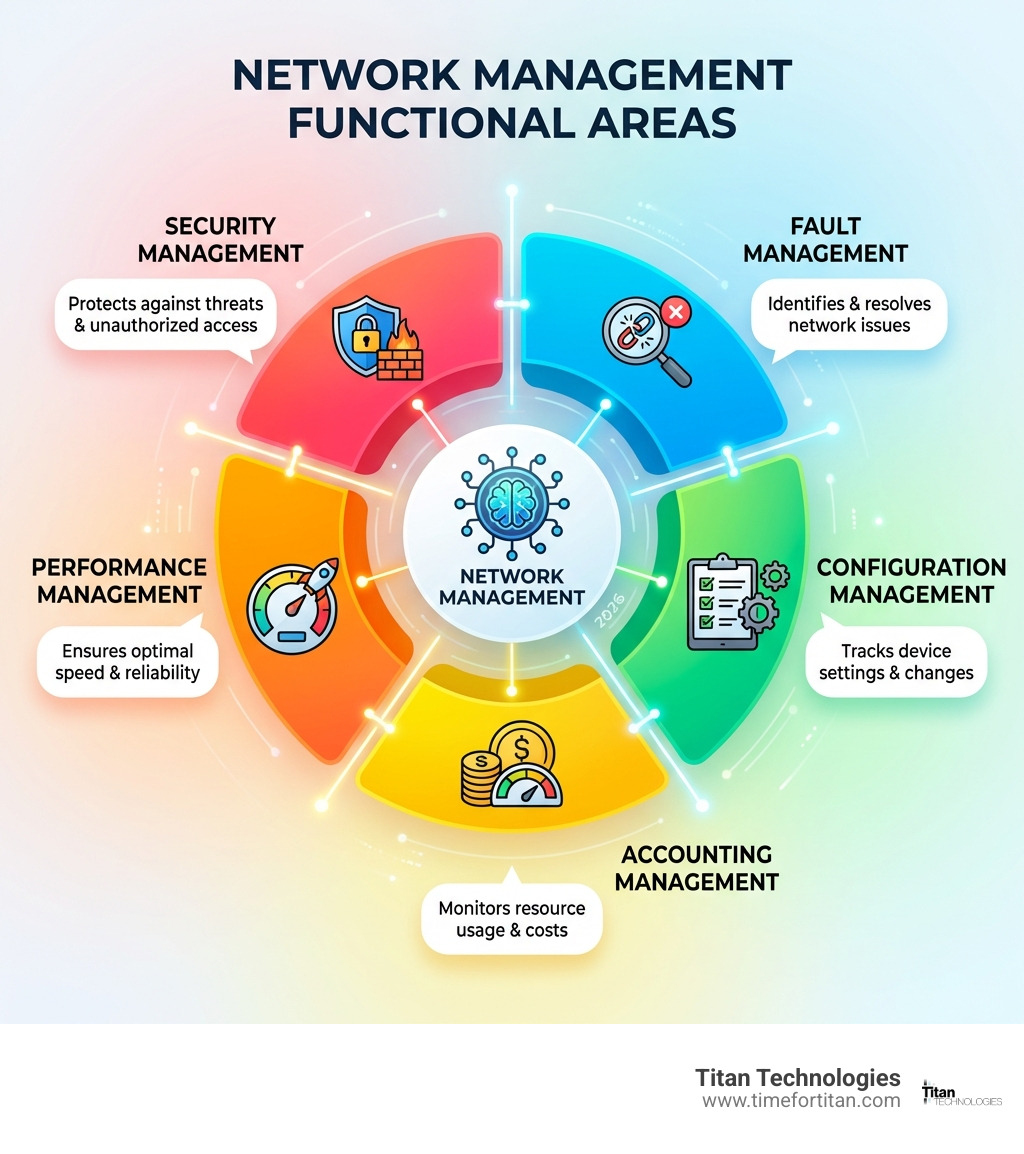
Effective network management and control addresses all of this. It combines fault management (fixing problems), configuration management (keeping settings consistent), accounting management (tracking usage), performance management (ensuring speed), and security management (protecting data). Together, these five functional areas—known as the FCAPS framework—create a complete approach to running a reliable, secure network.
I’m Paul Nebb, founder of Titan Technologies, and I’ve spent over 15 years helping businesses in Central New Jersey implement robust network management and control strategies that reduce downtime and protect against cyber threats. In this guide, I’ll walk you through everything you need to know to make informed decisions about managing your network effectively.
Terms related to network management and control:
The Core Pillars of Network Management and Control
To truly understand network management and control, we have to look at the pillars that support it. The industry standard for this is the FCAPS framework, developed by the International Organization for Standardization (ISO). It’s a bit of a mouthful, but it’s essentially the “to-do list” for any healthy network.

Here is a breakdown of the five functional areas every effective Network Management System (NMS) must cover:
- Fault Management: This is the “first responder” of your network. It identifies, isolates, and resolves abnormal conditions. When a switch in your Newark office goes offline, fault management tells you exactly what happened and why.
- Configuration Management: This pillar tracks and controls the settings on every device. If someone accidentally changes a setting on a router in Princeton, configuration management allows us to roll it back to a known working state. You can learn more about this in our guide on Network Configuration Management.
- Accounting Management: This isn’t just about money; it’s about resource tracking. It monitors how much bandwidth or storage different departments are using. It helps identify bottlenecks and ensures that one “bandwidth hog” doesn’t slow down the whole company.
- Performance Management: This ensures your network stays fast and reliable. We look at metrics like packet loss, response times, and link utilization to make sure your video calls don’t lag and your cloud apps stay snappy.
- Security Management: This is arguably the most critical pillar today. It involves reviewing security policies, managing access to network resources, and protecting against threats like viruses or unauthorized intrusions. For a deeper dive, check out our Network Security Management page.
These pillars aren’t just theoretical; they are backed by rigorous international standards. For those who enjoy the technical details, the RFC 6632: An Overview of the IETF Network Management Standards provides a comprehensive look at how these protocols are structured to ensure resource availability.
The Role of Automation in Network Management and Control
In the old days, network administrators had to log into every device manually to change a password or update a setting. Today, that’s impossible. With the rise of hybrid work and IoT, there are simply too many devices to manage by hand.
This is where automation comes in. By leveraging automated Network Configuration Management, we can:
- Reduce Human Error: 80% of network outages are caused by human error during manual configuration changes. Automation eliminates this risk.
- Enforce Policies: We can automatically push security policies to every device in your Elizabeth or Edison office simultaneously.
- Speed Up Deployment: Need to add ten new access points for a new branch in Red Bank? Automation can configure them in seconds rather than hours.
- Vulnerability Scanning: Automated tools can constantly scan your hardware for outdated firmware or known security holes.
Addressing Security within Network Management and Control
Security is no longer a separate “add-on” to your network; it must be baked into the management process. As we mentioned, cybercriminals can breach a network perimeter in 93% of businesses. If your network management and control strategy doesn’t prioritize security, you’re essentially leaving the front door open uped.
Modern Network Security focuses on “Identity-Driven Security.” This means the network doesn’t just look at the device; it looks at the user. Whether an employee is logging in from a coffee shop in Princeton or our office in Matawan, the same strict access controls follow them.
Encryption is another non-negotiable. Every piece of data flowing through your management system—from performance metrics to configuration files—must be encrypted to prevent “man-in-the-middle” attacks where hackers intercept your internal traffic.
Data Collection and Modern Protocols
How does a management system actually “see” what’s happening on your network? It uses specific protocols to collect data. Think of these as the languages your network devices use to talk to the central controller.
There are two primary ways we collect this data:
- SNMP (Simple Network Management Protocol): This has been the standard since the early 1990s. It works on a “query and response” model. The system asks a switch, “How much traffic are you seeing?” and the switch answers. While reliable, it can be slow in very large networks.
- Streaming Telemetry: This is the modern replacement for SNMP. Instead of waiting to be asked, devices use software agents to “push” real-time KPIs to the controller. It’s much faster, more scalable, and provides a far more detailed picture of network health.
Tools like the SolarWinds Network Performance Monitor use these protocols to give us a “single pane of glass” view of your entire infrastructure. Whether you’re using standards like NETCONF and YANG or open-source models like OpenConfig, the goal is the same: Network Monitoring and Management that catches issues before your employees even notice a slowdown.
Centralized vs. Decentralized Control Models
When setting up your network management and control architecture, you have to choose between two main philosophies: centralized or decentralized. Each has its pros and cons, especially for businesses with multiple locations across Central New Jersey.
| Feature | Centralized Management | Decentralized Management |
|---|---|---|
| Control | One central hub manages everything. | Each location or segment is managed locally. |
| Efficiency | High; policies are pushed once to all sites. | Lower; changes must be made at each site. |
| Risk | Potential “single point of failure.” | Resilient; one site’s failure doesn’t affect others. |
| Compliance | Easier to track and audit for HIPAA/FINRA. | Harder to maintain consistent records. |
| Complexity | Lower administrative overhead. | Higher overhead for IT teams. |
For most of our clients in Newark or Woodbridge, we recommend a hybrid model. This gives you the operational efficiency of centralized control via our Network Operations Center Services, while still allowing for local flexibility and failover protection.
Best Practices for Business Continuity
At Titan Technologies, we believe that “hope” is not a business strategy. You need a proactive plan to ensure your network stays up and running, no matter what happens.
Here are the best practices we implement for our Network Infrastructure Management Services:
- Establish a Baseline: You can’t know when something is wrong if you don’t know what “normal” looks like. We spend the first few weeks of any engagement mapping your network’s baseline behavior.
- Layered Troubleshooting: When a problem occurs, we don’t just guess. We use a layered approach—checking the physical connection, then the IP layer, then the application layer—to find the root cause quickly.
- Active vs. Passive Monitoring: We use “active” monitoring (sending synthetic traffic to test connections) and “passive” monitoring (watching real user traffic) to get a 360-degree view of your network health.
- Capacity Planning: Don’t wait until your network is at 99% utilization to buy more bandwidth. We use historical data to predict when you’ll need to scale up your infrastructure in Trenton or Lakewood.
- Failover Protection: Every critical system should have a “Plan B.” Whether it’s a backup internet circuit or a redundant server, failover protection ensures that a single hardware failure doesn’t cost you $9,000 per minute in downtime.
Conclusion
Managing a modern network is a full-time job. Between the constant threat of cyberattacks and the complexity of supporting a hybrid workforce, it’s easy for IT teams to feel overwhelmed. But you don’t have to do it alone.
At Titan Technologies, we provide comprehensive managed IT services and cybersecurity solutions custom for businesses in Central New Jersey. Whether you’re located in Edison, Elizabeth, or New Brunswick, our professional team is here to offer fast, reliable support with a 100% satisfaction guarantee. We ensure your network management and control is handled by experts, so you can focus on growing your business.
Ready to secure your network and eliminate downtime? Explore our Desktop Network Support services today and see how we can help you build a more resilient infrastructure.
What is the difference between network management and a network management system?
It’s a common point of confusion! Think of network management as the strategy and the tasks—it’s the act of provisioning, securing, and maintaining the network. A network management system (NMS) is the tool or software we use to perform those tasks. You need the right strategy (management) and the right tools (system) to be successful. Without the system, the tasks become manual and prone to error. Without the strategy, the tools are just expensive software that nobody knows how to use.
How do network management systems support hybrid work?
Hybrid work has changed the game. We no longer have a “perimeter” to defend; the edge of your network is now your employee’s kitchen table. Modern Network Management Services support this through technologies like SASE (Secure Access Service Edge) and Zero Trust Network Access (ZTNA). These systems ensure that no matter where an employee is, their connection is encrypted, their identity is verified, and their access is limited only to what they need for their job. This provides the agility businesses need without sacrificing security.
Why is “Adoption is the new ROI” important for NMS?
In IT software, there’s an old saying: “The best tool is the one that actually gets used.” A network management system could have a thousand features, but if it’s too complicated for your team to deploy or steer, it provides zero value. When we talk about “Adoption is the new ROI,” we mean that the true return on your investment comes from how easily and effectively the tool integrates into your daily operations. We prioritize tools that offer a great user experience and ease of deployment, ensuring you get the maximum operational value from your investment.