




Why Cyber Threat Protection Is the #1 Priority for Business Owners Right Now
Cyber threat protection is the use of tools, policies, and strategies to defend your business systems, networks, and data from malicious attacks — before, during, and after they happen.
Here’s a quick overview of what effective cyber threat protection covers:
| Layer | What It Does |
|---|---|
| Prevention | Blocks threats before they enter your network |
| Detection | Identifies suspicious activity in real time |
| Response | Contains and neutralizes active threats fast |
| Recovery | Restores operations after an incident |
Cyberattacks are no longer a problem only for large corporations. Small and mid-sized businesses are increasingly in the crosshairs — and the costs are staggering. A DDoS attack alone can cost $6,130 per minute of downtime. Attacks targeting known vulnerabilities have surged by 180% annually.
The threat landscape has also shifted fast. Ransomware, phishing, bot attacks, and zero-day exploits have grown more sophisticated. Meanwhile, traditional security tools like basic firewalls and legacy VPNs are struggling to keep up — 86% of threats now hide inside encrypted traffic that most firewalls can’t inspect at scale.
The good news? With the right layered defense strategy, you can stop most threats before they cause serious damage.
I’m Paul Nebb, founder of Titan Technologies and a cybersecurity expert with over 15 years of experience helping businesses navigate the complex world of cyber threat protection — from speaking at West Point and the Harvard Club to advising organizations across industries. In the sections ahead, I’ll walk you through exactly how modern cyber threats work and what you can do to stop them.
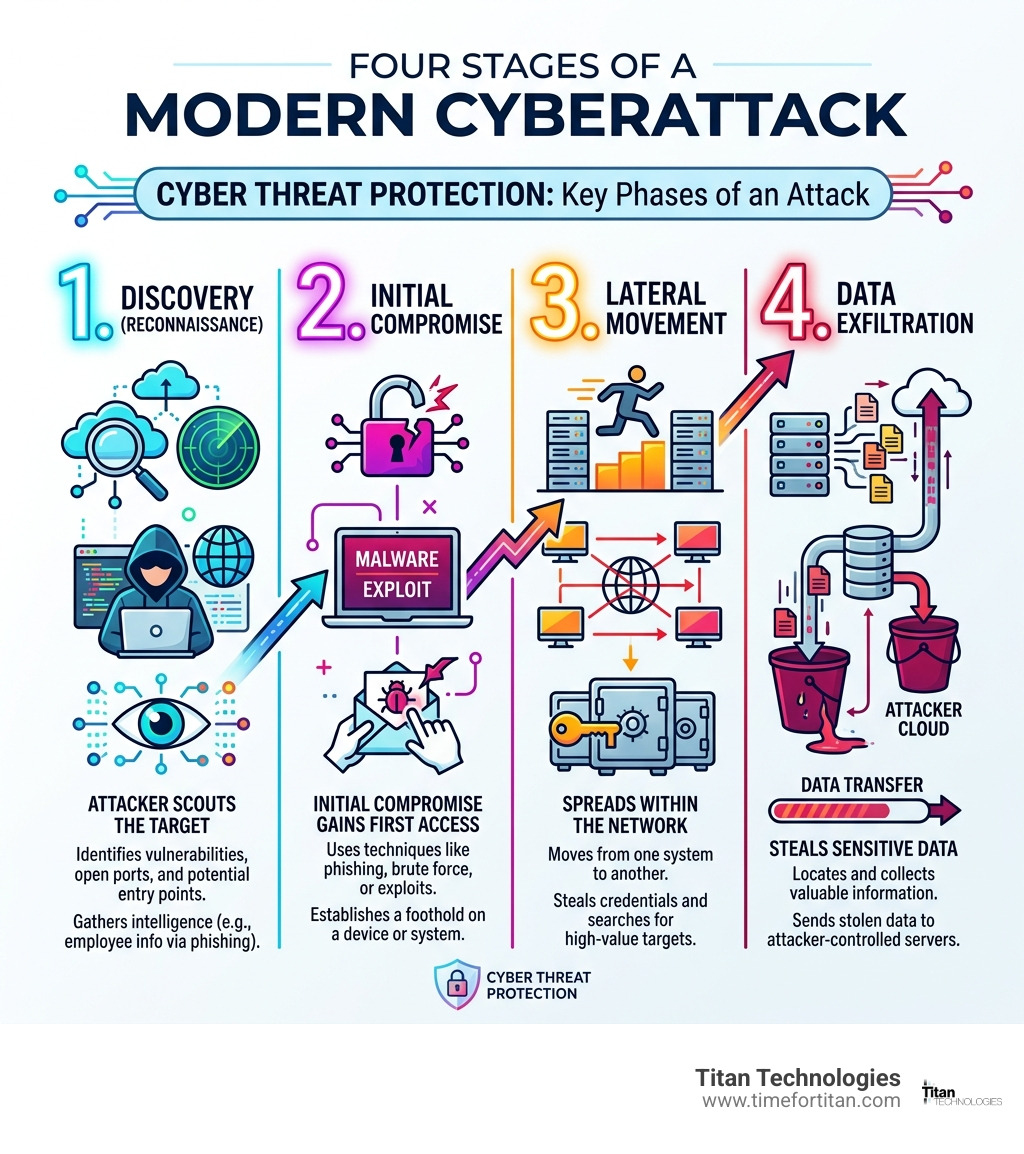
Understanding the Modern Landscape of Cyber Threat Protection
As we move through 2026, the digital world has become a bit like the Wild West, but with more fiber-optic cables and fewer tumbleweeds. For businesses in Central New Jersey—from the bustling hubs of Newark and Elizabeth to the professional corridors of Princeton—the risks are local and immediate.
The statistics are sobering. Beyond the $6,130 per minute cost of DDoS downtime, we have to look at the “big picture” impact. The Average Data Breach Now Costs $4.88 Million – What Would It Cost Your Business? According to the latest IBM Cost of a Data Breach Report, when you factor in legal fees, lost customer trust, and regulatory fines, a single slip-up can be catastrophic. Modern cyber threat protection isn’t just an IT expense; it’s a business continuity insurance policy.
Common Vectors: From Phishing to Ransomware
Threat actors are incredibly creative. They don’t just knock on the front door; they look for an unlocked window in your basement (or your smart thermostat).
- DDoS (Distributed Denial of Service): These attacks flood your systems with junk traffic, effectively “hugging” your website to death until it crashes.
- Malware and Ransomware: These are the heavy hitters. Ransomware has become the go-to extortion tool because remote work has exposed so many new vulnerabilities.
- Phishing: This remains the most common entry point. Human error is often the weakest link, which is How the S.E.C.U.R.E. Method Can Stop Phishing Emails Before They Harm Your Business by training your team to spot the bait.
- Bot Management: Not all bots are bad (think Google search bots), but malicious bots are used to scrape data or brute-force passwords.
- IoT and OT Attacks: We’ve seen a massive 400% increase in attacks targeting Internet of Things and Operational Technology devices. If it’s connected to your network—whether it’s a security camera in Edison or a manufacturing sensor in Trenton—it’s a target.
To stay ahead, you need to be aware of the 5 New Cybersecurity Threats You Need to Be Very Prepared for This Year.
Why Traditional Firewalls Fail Against Advanced Threats
If you’re still relying on a firewall you bought five years ago, you’re essentially using a screen door to stop a hurricane. Traditional firewalls were designed for a world where everyone sat in an office and traffic was “plain text.”
Today, 86% of threats hide in encrypted traffic. Because most older firewalls can’t perform TLS/SSL inspection at scale without slowing your internet to a crawl, they simply let that traffic through. It’s a massive blind spot.
Furthermore, 56% of enterprises were targeted by VPN-related attacks last year. Legacy VPNs create a “tunnel” into your network, but if a hacker steals a remote worker’s credentials, they have the keys to the kingdom. This is why we are seeing a massive shift toward cloud-native security architectures that don’t rely on outdated “perimeter” thinking.
Key Components of an Effective Defense Stack
Building a defense stack is like building a fortress. You don’t just want a wall; you want a moat, a drawbridge, and some very alert guards on the towers.
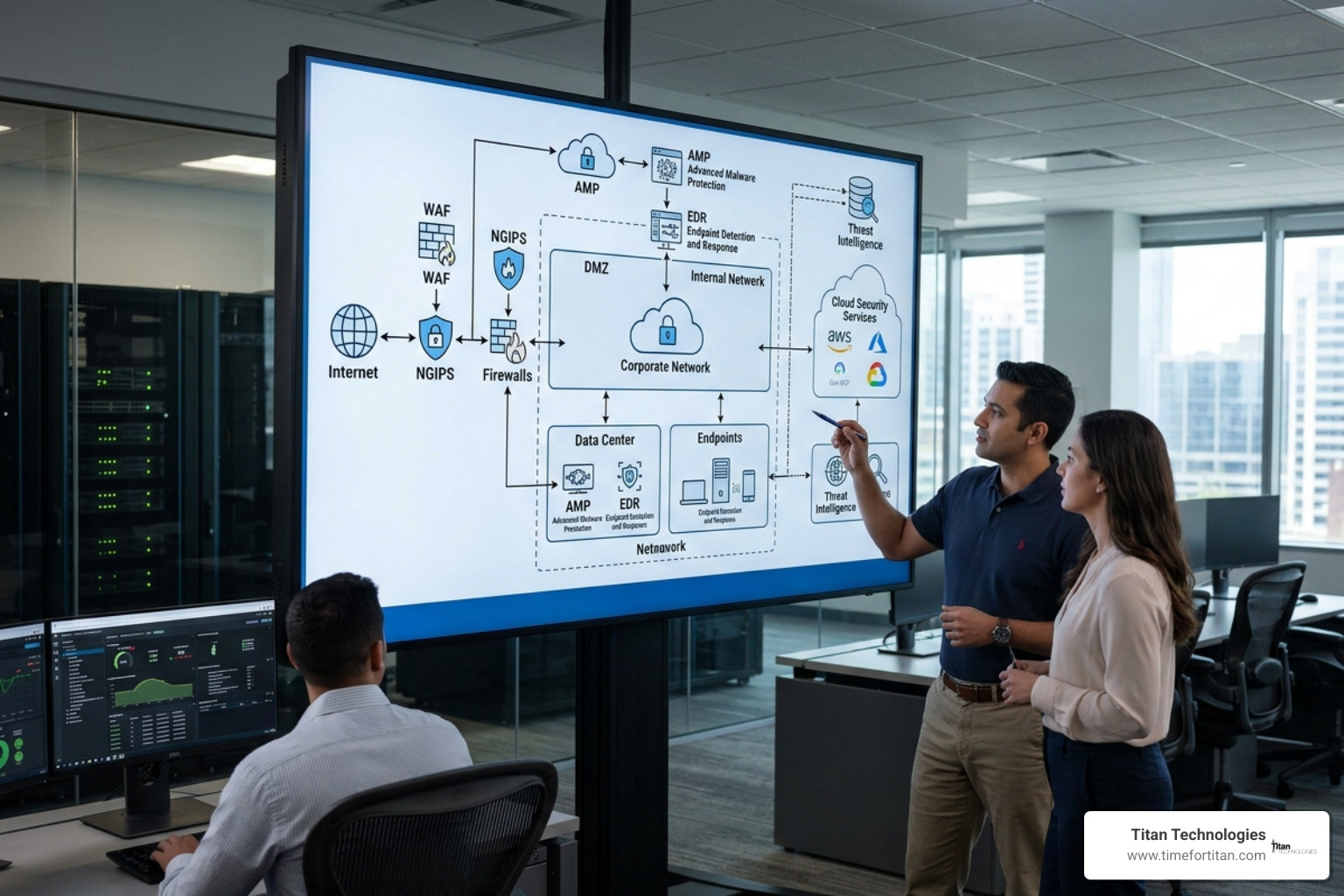
A modern cyber threat protection stack includes:
- WAF (Web Application Firewall): Protects your web-facing apps from common exploits.
- NGIPS (Next-Generation Intrusion Prevention System): Watches for suspicious patterns in network traffic.
- AMP (Advanced Malware Protection): Continuously analyzes files to catch “sleeper” malware that might bypass initial scans.
For businesses in our area, these components are the bread and butter of Cybersecurity. Whether you need Cybersecurity Services Princeton NJ or support in Matawan, these tools must work together seamlessly.
Integrated SIEM and XDR for Unified Visibility
In the old days, security tools lived in “silos.” Your antivirus didn’t talk to your firewall, and your firewall didn’t talk to your email filter. This led to “alert fatigue”—thousands of notifications that no human could possibly manage.
Integrated SIEM (Security Information and Event Management) and XDR (Extended Detection and Response) change the game. They provide Unified Threat Detection, Investigation, and Response (TDIR).
- Speed: Integrated solutions can reduce threat response time by up to 88%.
- Effectiveness: They reduce the risk of a breach by 60% by correlating data from endpoints, cloud, and network traffic to see the “whole” attack.
This level of Security allows us to see an attack starting on a laptop in Lakewood and stop it before it reaches your servers in New Brunswick.
Proactive Cyber Threat Protection via Threat Intelligence
Why wait for an attack to happen to learn how to stop it? Modern protection uses Threat Intelligence gathered from global networks.
We utilize data from global “honeypots”—decoy systems designed to attract hackers. By watching how hackers try to break into these decoys, we get first-hand data on their new tactics. This real-time sharing of Indicators of Compromise (IOCs) means that if a new virus is spotted in Europe, your network in Freehold can be protected against it before it even reaches the U.S. Check out our Cybersecurity Tip of the Week for more ways to stay proactive.
Strategic Frameworks and Best Practices for Prevention
The best way to handle a cyber threat is to make sure it never gets past the front gate. This requires a combination of the right technology and the right “rules of engagement.”
Implementing Zero Trust and Network Segmentation
The old security model was “trust, then verify.” The new model is Zero Trust: “Never trust, always verify.”
In a Zero Trust architecture, no user or device is trusted by default, even if they are already inside the network. We use:
- Least Privilege Access: Employees only get access to the specific files they need for their jobs.
- Identity-Based Access: Verification is based on the user’s identity and device health, not just a password.
- Network Segmentation: We divide your network into smaller “rooms.” If a hacker gets into one room, they can’t just wander into the rest of the house. This stops “lateral movement.”
This is a core part of modern Network Security. By reducing the attack surface, we make it much harder for a threat to find anything valuable.
Leveraging MITRE ATT&CK for Cyber Threat Protection
How do we know if your defenses are actually working? We use the MITRE ATT&CK framework. This is a global knowledge base of adversary tactics and techniques based on real-world observations.
By mapping your security stack against this framework, we can identify exactly where your blind spots are. Organizations that align their defense to these techniques see a 70% gain in control coverage.
| Defense Type | Focus | Benefit |
|---|---|---|
| Technique-Based | High-level actions (e.g., “Phishing”) | General awareness of threat types |
| Procedure-Based | Specific “how-to” steps used by hackers | 50% fewer blind spots; stops real-world attacks |
A thorough Cyber Security Assessment will use these frameworks to ensure you aren’t just buying tools, but actually building a defense that stops real adversary behavior.
Overcoming Operational Challenges in Cybersecurity
The biggest hurdle for many businesses in 2026 isn’t just the hackers—it’s the complexity of the defense. Between the talent shortage and the sheer volume of data, it’s easy to feel overwhelmed.
Reducing Alert Fatigue with AI and Automation
If your IT person is getting 500 security alerts a day, they’re going to start ignoring them. That’s where Agentic AI and machine learning come in.
Modern cyber threat protection uses AI to:
- Filter the Noise: AI can automatically dismiss 95% of “false positives,” leaving only the high-priority threats for humans to look at.
- Automated Playbooks: If a known type of attack occurs, the system can automatically isolate the infected computer and block the malicious IP address in seconds—much faster than a human could.
This is especially vital for Strengthening Healthcare Cybersecurity: Insights from the Ascension Cyberattack, where every second of downtime can impact patient care.
The Role of Managed Detection and Response (MDR)
Most small businesses in Woodbridge or Elizabeth don’t have the budget for a 24/7 “War Room” staffed by elite security analysts. This is where Managed Detection and Response (MDR) comes in.
MDR provides you with a professional Security Operations Center (SOC) that monitors your network around the clock. You get the benefit of expert oversight and advanced tools without the overhead of hiring a full-time internal team. This is one of the most effective Cybersecurity Solutions for SMBs available today. It bridges the talent gap and ensures that whether an attack happens at 2:00 PM or 2:00 AM, someone is watching. If you are looking for Cybersecurity Freehold, MDR is often the missing piece of the puzzle.
Frequently Asked Questions about Cyber Threat Protection
How does threat intelligence improve proactive defense?
Threat intelligence acts like a global neighborhood watch. By collecting data on active attacks from around the world, your security systems can be updated to recognize those specific threats before they ever touch your network. It moves you from “reacting” to “anticipating.”
What is the difference between EDR and XDR?
EDR (Endpoint Detection and Response) focuses specifically on protecting individual devices like laptops and servers. XDR (Extended Detection and Response) takes it a step further by integrating data from your network, email, cloud apps, and endpoints into a single, unified view. XDR gives you the “big picture” of an attack.
Why is TLS/SSL inspection critical for modern firewalls?
Almost all web traffic today is encrypted (the “HTTPS” you see in your browser). While this protects your privacy, hackers also use that encryption to hide malware. Without TLS/SSL inspection, your firewall is essentially a security guard who isn’t allowed to look inside the bags people are carrying into the building.
Conclusion
The world of cyber threats is moving fast, but you don’t have to face it alone. At Titan Technologies, we provide the advanced cyber threat protection and managed IT services that Central New Jersey businesses need to thrive. From our offices in Edison, Elizabeth, and Princeton to our support teams in Lakewood and Freehold, we are committed to your security.
Our professional team offers fast, reliable support with a 100% satisfaction guarantee. We don’t just “fix computers”—we ensure efficient network management and advanced security so you can focus on growing your business.
Could a Hacker Take Down Your Business? Don’t wait for a crisis to find out. Protect your assets with comprehensive cybersecurity from Titan Technologies today. Reach out to us for a consultation, and let’s make sure your business is ready for whatever 2026 throws your way.