




Why Cloud Migration is Essential for Modern Business Success
Cloud migration services are professional solutions that help businesses move their data, applications, and IT infrastructure from on-premises systems to cloud-based platforms. This digital change is more than a technology upgrade; it’s a strategic decision that can revolutionize how your company operates, scales, and competes. These services typically involve assessment, strategy development, execution support, security implementation, and post-migration optimization.
As one industry expert noted, “Migrating to the cloud is important, but what you do with your data once it’s there matters most.” The cloud enables businesses to adopt advanced analytics and AI, modernizing operations and turning data into actionable insights. For small and medium-sized businesses in New Jersey, this means gaining enterprise-level capabilities like scalability, flexibility, and security without massive infrastructure costs.
However, a successful migration requires navigating technical and organizational barriers, such as legacy systems, skill gaps, and data privacy concerns.
I’m Paul Nebb, founder of Titan Technologies, and I’ve been helping businesses steer complex technology changes since 2008. My experience with cloud migration services spans from large corporations to small businesses, ensuring secure, strategic transitions that align with each organization’s unique goals.
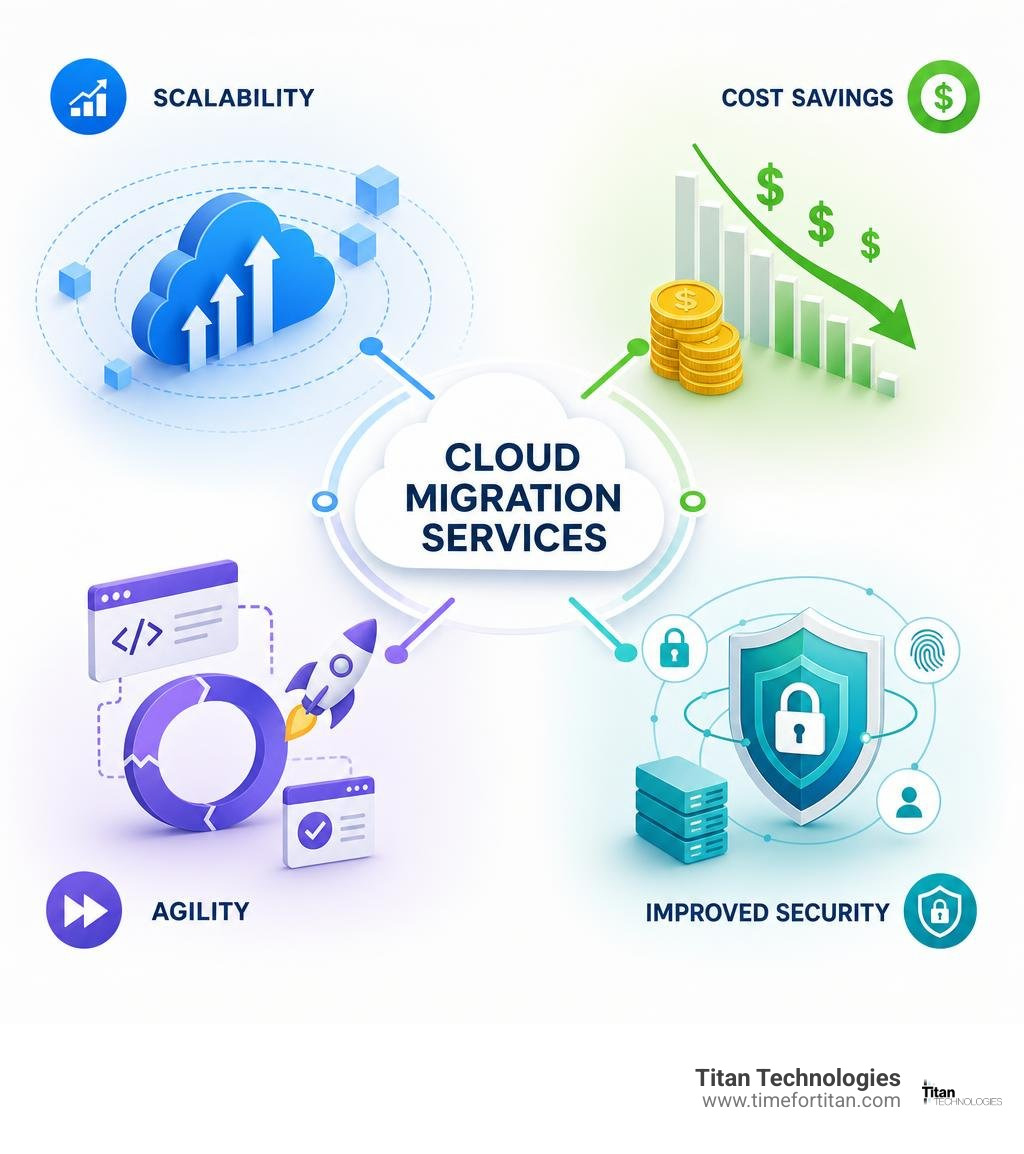
The ‘Why’: Unpacking the Benefits and Challenges of Cloud Migration
When I talk to business owners about cloud migration services, they often ask, “Why change when our current systems work?” The answer goes beyond technology trends. Think of it like a home renovation: your old kitchen works, but a modern one transforms how you live. The cloud does the same for your business—it doesn’t just maintain operations, it revolutionizes what’s possible.
Primary Benefits of Migrating to the Cloud
Let me share what I’ve seen happen when businesses make the leap. The change is often more dramatic than they expect.

Agility becomes your competitive advantage. Instead of waiting weeks for IT to set up new hardware, you can have a new environment running in minutes. Your team can test ideas, launch projects, and respond to market changes faster than ever.
Scalability happens on demand. If your website traffic suddenly spikes, cloud infrastructure automatically scales up to handle the load, then scales back down. This pay-as-you-go model shifts IT spending from large upfront investments to predictable operational expenses that grow with your business.
Global reach becomes accessible to all. Your applications can run closer to customers worldwide, ensuring a lightning-fast experience for everyone, regardless of location.
Disaster recovery transforms from a complex challenge into a built-in feature. Your data and applications are automatically replicated across multiple locations, ensuring business continuity. For more insights, check out our guide on Cloud Computing and Disaster Recovery.
Innovation access opens doors to tools like artificial intelligence and machine learning. You can analyze customer behavior and automate tasks with capabilities once reserved for Fortune 500 companies.
Improved security often surprises business owners. Major cloud providers invest billions in security, employing teams of experts and advanced threat detection systems that far exceed what most individual companies can afford.
Common Challenges to Overcome
Cloud migration isn’t always a simple process. Knowing the common problems makes all the difference.
Complexity is often the first one. Legacy systems have intricate dependencies that require careful planning to untangle.
Downtime risk is a major concern, but with a detailed migration plan that includes testing and rollback procedures, it can be minimized or even eliminated.
Security vulnerabilities can arise during the transition. The journey to the cloud creates temporary exposure points that must be managed by experienced cloud migration services.
Compliance management adds another layer, especially for regulated industries. Your data and cloud environment must meet all regulatory requirements from day one.
Vendor lock-in is a valid concern. A smart migration strategy maintains flexibility and avoids proprietary technologies that tie you to a single provider.
Unforeseen costs can occur without thorough planning. Proper cost modeling and ongoing optimization are key to realizing the expected savings.
Cultural resistance can be the biggest challenge. Successful migrations include comprehensive training and clear communication about how the cloud will empower your team.
Before starting, we always work with clients to conduct a comprehensive assessment, define clear business objectives, map security and compliance needs, perform a realistic cost analysis, evaluate skills gaps, and plan for risk mitigation. The challenges are real, but they are manageable with the right partner.
The ‘How’: Developing Your Cloud Migration Services Strategy
Moving from “why” to “how” requires a thoughtful, strategic approach. You wouldn’t move without a plan, and the same is true for your digital assets. Fortunately, cloud migration services now follow proven methodologies to guide your journey.
Choosing the Right Migration Strategy: The 6 R’s
Not every application needs the same treatment. The industry has settled on what we call the “6 R’s” of migration—six distinct strategies for different workloads.
- Rehosting (Lift-and-Shift): Moving applications to the cloud with minimal changes. It’s fast and ideal for apps that work well as-is.
- Replatforming (Lift-and-Tinker): Moving applications with some cloud-specific improvements, like using a managed database service to gain benefits without a complete overhaul.
- Repurchasing (Drop-and-Shop): Switching to a new, cloud-based service, such as moving from an on-premise email server to Microsoft 365.
- Refactoring or Re-architecting: Completely redesigning applications to take full advantage of cloud-native features. This requires more effort but delivers transformative results.
- Retaining: Acknowledging that some applications are better left on-premise for now due to complexity or regulatory requirements.
- Retiring: The simplest strategy—turning off applications that are no longer in use to eliminate cost and complexity.
Essential Steps in a Successful Cloud Migration Plan
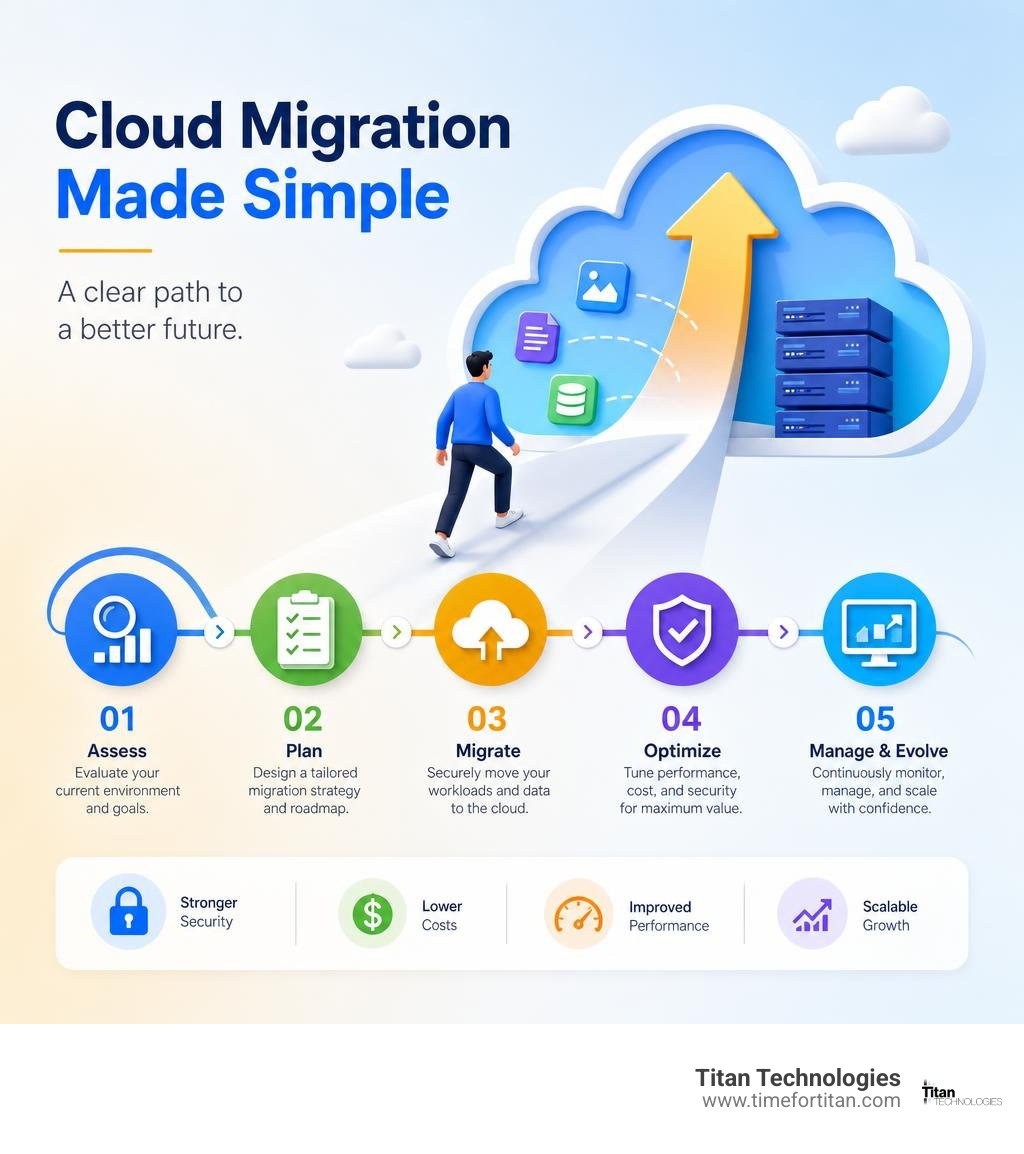
Every successful migration follows a refined process to ensure a smooth and secure transition.
- Assessment and Findy: We start by mapping your entire IT environment—applications, servers, and dependencies. Modern AI-powered tools can provide actionable insights in as little as 48 hours.
- Strategy and Planning: We match each workload to the right “6 R’s” strategy, design the target cloud architecture, and create a detailed roadmap that defines success for your business.
- Environment Preparation: We build your new cloud home by setting up networks, security policies, and user access controls before the move begins.
- Migration Execution: We execute the move using automated tools and careful data transfers, always focused on minimizing disruption to your daily operations.
- Validation and Testing: We run comprehensive tests to verify performance, security, and functionality, ensuring business processes flow smoothly.
- Post-Migration Optimization: The journey continues after migration. We fine-tune resources for cost efficiency, improve performance, and help you leverage new cloud capabilities.
How to Choose the Right Cloud Migration Partner
Selecting the right partner is perhaps the most critical decision in this process.
Look for proven expertise with a solid track record and real client testimonials. Industry-specific knowledge is also vital, as a partner should understand the unique regulatory and compliance challenges of your field, whether it’s healthcare, legal, or manufacturing. A good partner uses comprehensive methodologies and tools, leveraging automation to make migrations faster and less risky.
Strong security credentials are non-negotiable. Ensure your partner has robust security protocols and deep compliance expertise. Crucially, they must offer post-migration support, as the real work of optimization begins after the move. At Titan Technologies, our famous 15-minute average response time reflects our commitment to your long-term success. Finally, look for clear communication and transparency.
For businesses in Central New Jersey, a local partner offers tangible benefits. We’re in your backyard, ready for hands-on collaboration. For more on our regional expertise, see our Cloud Computing Services NJ page. A great partner is a trusted advisor who aligns technology with your business goals.
The ‘What’: Executing a Secure and Modern Migration
With strategy in place, execution begins. This phase involves moving your applications and data while modernizing your infrastructure and ensuring robust security. It’s not just about relocating digital assets; it’s about upgrading them. The process covers application and infrastructure modernization, data migration, and implementing security protocols, often leveraging AI and automation for efficiency.
How Cloud Migration Services Address Security and Compliance
Security is not an afterthought; it’s woven into every step. When done right, cloud security often exceeds what most organizations can achieve on their own.
- Data Encryption: We encrypt your data both in transit and at rest, ensuring it remains protected even if intercepted.
- Identity and Access Management: We implement multi-factor authentication and least-privilege access policies to ensure only authorized personnel can access your systems.
- Threat Detection: Modern cloud environments feature advanced, 24/7 threat detection that spots suspicious activity faster than humanly possible.
- Compliance Frameworks: We design your cloud environment to be compliant with regulations like HIPAA, GDPR, and SOC 2 from the start. For more details, see our Data Protection Cloud-Based Services.
- Proactive Monitoring: Continuous oversight provides detailed logs and helps us detect potential issues before they become problems, supplying a necessary audit trail.
- Secure Network Architecture: We build multiple layers of protection using virtual private clouds, firewalls, and network segmentation.
The Role of AI and Automation in Modern Migration
AI and automation are changing cloud migration, making it faster, more reliable, and more efficient.
AI-powered assessment tools can map your entire IT environment in a fraction of the time it once took, providing actionable insights in as little as 48 hours. Automated wave planning uses algorithms to create an optimal migration sequence, minimizing business disruption. This reduction in manual effort not only speeds up the process but also dramatically reduces the risk of human error.
Cost optimization engines use AI to predict resource needs and recommend the most cost-effective configurations, potentially saving up to 50% on cloud spending. Predictive analytics help us spot potential bottlenecks before they occur, ensuring a smooth migration and optimal performance. For more on this, read our article on AI in Cloud Migration.
Key Considerations for Data and Application Modernization
Moving to the cloud is the perfect opportunity to modernize your applications and data.
Data integrity is our top priority. We use techniques like continuous replication to ensure your data remains consistent and complete with minimal downtime. We also evaluate database refactoring, migrating to cloud-native database services for better performance and lower maintenance.
Application containerization (using Docker and Kubernetes) makes applications more portable and scalable. We can also break down large applications into microservices for greater flexibility and faster innovation. Leveraging cloud-native services like serverless functions frees your team to focus on business logic instead of server maintenance. For specialized workloads like SAP or mainframes, we apply targeted approaches to meet their unique requirements. Our goal is to ensure your applications don’t just survive the move—they thrive. For comprehensive protection, explore our Cloud Backup Services NJ.
Life After Migration: Maximizing Value and Measuring Success
Your cloud migration services project is complete, but the journey is just beginning. A cloud environment is a living ecosystem that needs ongoing care and strategic management to deliver its full value. This is where your initial investment truly starts paying dividends.
How Managed Cloud Services Support Your Business Post-Migration
Managed cloud services are like having a dedicated team of experts watching over your digital infrastructure 24/7.
- 24/7 Monitoring and Support: Our team is always watching for signs of trouble, ready to act before problems impact your business. At Titan Technologies, our 15-minute average response time means we’re there when you need us most.
- Proactive Maintenance: We constantly tune, update, and optimize your cloud environment to prevent issues before they happen, keeping everything running smoothly.
- Security Management: As threats evolve, we provide constant vigilance, monitoring for vulnerabilities, managing access controls, and ensuring ongoing compliance.
- Performance and Cost Optimization: We analyze performance metrics to identify bottlenecks and continuously monitor usage to find cost-saving opportunities, helping you avoid “bill shock.”
- Expert Guidance: We act as an extension of your team, helping you leverage new features and align your cloud strategy with your business goals. Our local New Jersey expertise ensures you get personalized attention.
This continuous support ensures your cloud investment delivers sustained value. Learn more about our comprehensive offerings at Cloud Services New Jersey.
Measuring the Success and ROI of Your Cloud Migration
Was the migration worth it? Measuring success is straightforward if you track the right metrics.
Financial improvements are often the most obvious, with a shift from high capital expenses to predictable operational costs. Some organizations report up to 52% lower Total Cost of Ownership. Performance metrics also tell a compelling story, with improved application response times and higher system uptime.
| KPI Category | Pre-Migration Metrics (On-Premises) | Post-Migration Metrics (Cloud) |
|---|---|---|
| Financial | High CapEx, unpredictable OpEx (maintenance) | Reduced CapEx, predictable OpEx (pay-as-you-go) |
| Cost | Data center costs, hardware refresh cycles | Reduced infrastructure costs, optimized cloud spend |
| Performance | Latency, application response times, uptime | Improved latency, faster response, higher uptime |
| Scalability/Agility | Manual scaling, slow provisioning | Automated scaling, rapid provisioning |
| Efficiency | IT staff time on maintenance, manual processes | IT staff on innovation, automated operations |
| Security/Compliance | Manual security audits, limited threat detection | Automated security, real-time threat detection |
| Business Value | Time-to-market for new features, innovation pace | Faster feature deployment, accelerated innovation |
| Disaster Recovery | RTO/RPO (Recovery Time/Point Objective) | Improved RTO/RPO, reduced DR costs |
Business agility improves as your teams launch new features and respond to market changes more quickly. Operational efficiency increases as your IT staff shifts from maintenance to innovation. Finally, improved security posture and higher user satisfaction are key indicators of a successful migration.
By monitoring these KPIs, we help you demonstrate tangible ROI and ensure your cloud investment remains a source of competitive advantage. To learn more about optimization, read our guide on Lower TCO by migrating to the cloud.
Conclusion: Your Next Steps Toward a Seamless Cloud Transition
As we’ve seen, cloud migration services are not just about moving servers. This transition is about fundamentally changing how your business operates, grows, and competes. The benefits—scalability, flexibility, security, and cost savings—are compelling. While challenges like legacy systems and change management are real, they are manageable with the right strategy and partner.
Choosing the right partner is critical. You need a team that understands your business, not just the technology. At Titan Technologies, we’ve been that trusted partner for businesses across Central New Jersey since 1996. From Edison to Princeton, we’ve helped organizations transform their IT into secure, efficient solutions that support their goals. Our professional team brings peace of mind with a 100% satisfaction guarantee and fast, reliable support.
A successful migration is a journey, not a destination. The real value comes from what you do once you’re in the cloud: scaling instantly, innovating freely, and operating with the confidence of enterprise-grade security. This journey is about future-proofing your business, positioning you to lead change rather than just keep up with it. The businesses that thrive will be the most agile and secure—that is the promise of the cloud.
Ready to take the next step? We’d love to help you steer the complexities of cloud migration and open up its full potential for your business.