




What Is VoIP Phone Service — and Why It Matters for Your Business
VoIP phone service is a technology that lets you make and receive phone calls using your internet connection instead of a traditional phone line.
Quick answer:
| Question | Answer |
|---|---|
| What does VoIP stand for? | Voice over Internet Protocol |
| How does it work? | Converts your voice into digital data packets sent over the internet |
| What do you need? | A broadband internet connection plus a device (phone, computer, or adapter) |
| Who is it for? | Businesses and home users looking to replace or upgrade traditional phone lines |
| Key benefits | Lower costs, advanced features, remote flexibility, scalability |
| Key risks | Relies on internet; 911 and power outage limitations to be aware of |
Traditional phone lines have been the backbone of business communication for decades. But in April 2026, they are increasingly being replaced — and for good reason.
VoIP works by breaking your voice into small digital packets, sending them across the internet, and reassembling them on the other end. The result is a phone call — often with better clarity than a copper-wire landline — delivered at a fraction of the cost.
For small and mid-sized businesses in Central New Jersey, the switch to VoIP is not just about saving money. It is about gaining features that traditional phone systems simply cannot offer: voicemail-to-email, auto-attendants, CRM integration, mobile apps, and video conferencing — all on one platform.
The Public Switched Telephone Network (PSTN) — the old copper-wire system — is actively being phased out in many countries. Businesses that have not yet evaluated VoIP are working with a system that is running out of time.
I’m Paul Nebb, founder of Titan Technologies and a cybersecurity and IT infrastructure expert with over 15 years of experience helping businesses across Central New Jersey modernize their communications — including deploying and securing VoIP phone service for organizations of every size. In this guide, I’ll walk you through everything you need to know to make a confident, informed decision.
Understanding the Mechanics of VoIP Phone Service
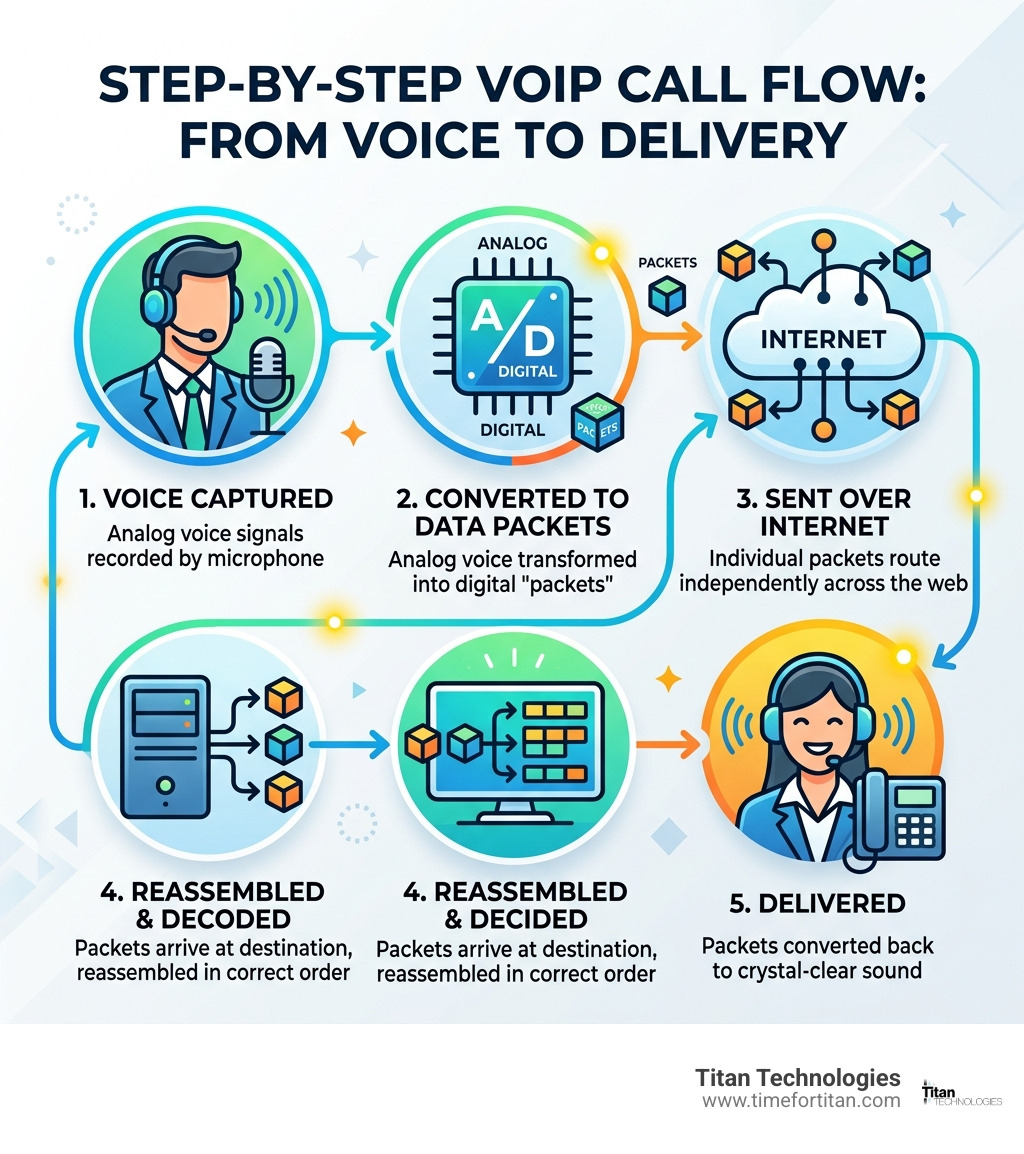
To understand why VoIP phone service is so transformative, we need to look under the hood. Traditional telephony relies on circuit switching, a technology that opens a dedicated physical path between two callers. In contrast, VoIP uses “packet switching.”
When you speak into a VoIP-enabled device, your analog voice signal is instantly converted into digital data. This data is sliced into small “packets,” each labeled with a destination address. These packets zip across the internet independently, finding the fastest route possible, and are reassembled into crystal-clear audio at the receiver’s end.

This process is governed by specific protocols that ensure your “Hello” doesn’t sound like a garbled mess. The Session Initiation Protocol (SIP) acts as the digital operator, signaling the start, middle, and end of a call. Meanwhile, the Real-time Transport Protocol (RTP) handles the actual delivery of the audio data. Because VoIP Services use the same language as the rest of your office network (Internet Protocol), they integrate seamlessly with your computers and software.
Essential Hardware for Your VoIP Phone Service
One of the best things about modern Business Phone Systems New Jersey is the flexibility in hardware. You don’t necessarily need to throw away your old equipment, though upgrading often unlocks more power.
- IP Handsets: These look like traditional desk phones but plug directly into your internet router or a PoE (Power over Ethernet) switch.
- Analog Telephone Adapters (ATA): If you love your old “fossilized dinosaur” landline phone, an ATA can bridge the gap. It’s a small box that allows traditional phones to talk to the digital VoIP network.
- Softphones: These are applications installed on your computer or smartphone. They turn your existing devices into full-featured business extensions, perfect for hybrid work.
- PoE Switches: These provide both data and power to your IP phones through a single cable, reducing clutter in your Edison or Princeton office.
Many businesses now opt for Hosted Phone Solutions, where the “brains” of the phone system live in a secure data center. This means you don’t need a bulky, expensive PBX box taking up space in your closet.
Internet Quality and Bandwidth Requirements
Since your voice is now traveling as data, the quality of your internet connection is paramount. Think of your internet as a highway; if there’s too much traffic, your voice packets get delayed.
We often look at three key metrics when evaluating VoIP Solutions New Jersey:
- Latency: The time it takes for data to travel from point A to point B. High latency causes that awkward “walkie-talkie” delay where callers talk over each other.
- Jitter: The variation in packet arrival times. If packets arrive out of order, the audio sounds “choppy.”
- Packet Loss: If packets go missing entirely, you’ll hear gaps in the conversation.
To fix this, we implement Quality of Service (QoS) settings on your router. This tells your network to prioritize voice traffic over less urgent data, like a large file download or someone streaming a video in the breakroom. In cities like Newark and Trenton, where high-speed fiber optic connections are common, these issues are much easier to manage than they were a decade ago.
Advantages of Switching from Landlines to VoIP
Why are so many businesses in Lakewood and Elizabeth making the switch? The short answer is that VoIP phone service does more for less.
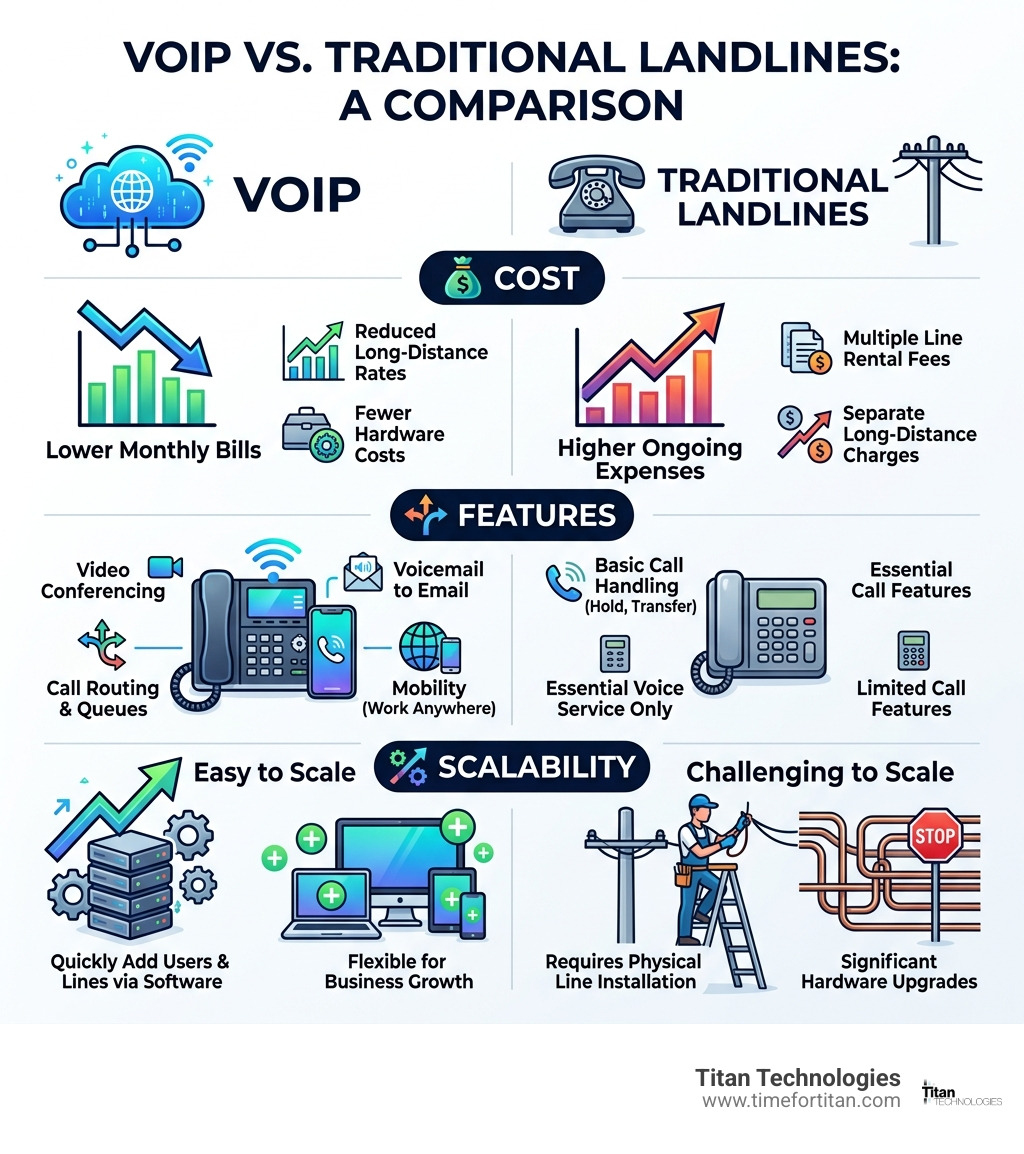
The cost savings are often the first thing people notice. By eliminating the need for separate copper phone lines and significantly reducing long-distance and international rates, businesses can often cut their monthly telecom spending by up to 50%.
But beyond the bill, Business Phone Service NJ offers unmatched flexibility. If you move your office from Matawan to Woodbridge, you simply unplug your phones and plug them in at the new location. Your numbers stay the same, and there’s no waiting for a technician to wire the building. Furthermore, VoIP supports the modern “work from anywhere” model. Your team can answer office calls from their laptops or mobile apps as if they were sitting at their desks.
Even traditional services have gone digital. With a Business Fax Service, you can send and receive faxes through your email, eliminating the need for paper, toner, and a dedicated fax line.
Advanced Features of Modern VoIP Phone Service
Traditional landlines are “dumb”—they make and receive calls. Modern VoIP is “smart.” It’s a unified communications platform that integrates with your entire business workflow.
- Auto-Attendant: A virtual receptionist that greets callers and routes them to the right department.
- Voicemail-to-Email: Receive an audio file and a text transcription of your voicemails directly in your inbox.
- CRM Integration: When a client calls, their account history can automatically pop up on your screen, allowing for better customer service.
- Video Conferencing: Many VoIP plans include built-in video meeting tools, reducing the need for separate, expensive subscriptions.
- Call Queuing: Professional “hold” systems that manage high call volumes for sales or support teams.
- Hosted Fax: Using Hosted Fax Solutions ensures your documents are handled digitally and securely.
Navigating Challenges: Reliability, Security, and E911
We wouldn’t be doing our job as IT experts if we didn’t talk about the hurdles. Because VoIP phone service relies on the internet and electricity, a “set it and forget it” approach won’t work.
If your power goes out, your internet router goes down, and so do your phones. To prevent this, we recommend uninterruptible power supplies (UPS) or battery backups for your critical networking gear. Additionally, most modern VoIP systems have a “mobile failover” feature—if your office goes dark, calls are automatically routed to your staff’s cell phones.
Security is another major consideration. Just like any other internet-connected device, VoIP systems can be targeted by hackers. We use Network Security best practices, including voice encryption and secure SIP trunks, to ensure your private conversations stay private. This is especially critical for industries using HIPAA Compliant Fax and voice services to protect sensitive patient data.
Emergency 911 (E911) and Regulatory Compliance
One of the most important differences between landlines and VoIP is how they handle emergency calls. A traditional phone is tied to a physical copper wire at a specific address. A VoIP phone can be anywhere.
The FCC requires “interconnected” VoIP providers to offer Enhanced 911 (E911). This means the provider must transmit the caller’s registered location to the emergency operator automatically. If you move your VoIP phone from your office in Princeton to your home in Red Bank, you must update your registered address in the system, or emergency services won’t know where to find you.
Providers must also comply with the Communications Assistance for Law Enforcement Act (CALEA) and contribute to the Universal Service Fund. When looking for Regional VoIP Information, always ensure your provider meets these Local Service Standards to avoid legal and safety gaps.
Choosing the Right VoIP Provider for Your Business
Selecting a provider is more than just looking at the lowest monthly price. In fact, the “cheapest” option often results in a higher Total Cost of Ownership (TCO) due to poor reliability or hidden fees.
When we help clients choose, we look for:
- Service Level Agreements (SLA): Look for an uptime guarantee of at least 99.99%.
- Scalability: Can you add or remove users in minutes as your business grows or seasonal demands change?
- Technical Support: Does a real person in New Jersey answer the phone when you have a problem, or are you stuck in an endless automated loop?
- Integration: Does the service play nice with your Cloud Services and other Managed IT Services?
For businesses in Central NJ, having a local partner who understands the local infrastructure—from the fiber lines in New Brunswick to the wireless hotspots in Matawan—can make the difference between a smooth transition and a communication nightmare.
Frequently Asked Questions about VoIP
Does VoIP work during a power outage?
By itself, no. Unlike old copper lines that carry their own low-voltage power, VoIP hardware needs electricity. However, we solve this using battery backups (UPS) for your router and phones. Most systems also allow for instant call forwarding to cellular devices, so you never miss a call even if the lights go out.
Can I keep my existing business phone number?
Absolutely. This process is called “number porting.” You’ll sign a Letter of Authorization (LOA), and your new provider will work with your old one to move the number over. At Titan Technologies, we often help clients through this transition to ensure there is zero downtime. You can learn more about our successful transitions at Thank You VoIP.
Is VoIP secure for sensitive industries like healthcare or law?
Yes, provided it is set up correctly. We implement end-to-end encryption, multi-factor authentication (MFA), and secure SIP trunks to meet the highest security standards. For those in the medical field, we ensure your voice and HIPAA Compliant Fax solutions meet all federal privacy requirements.
Conclusion
The transition to VoIP phone service is no longer a “future” consideration—it is a present-day necessity for any business looking to remain competitive, mobile, and efficient in 2026. From the cost savings of eliminating old landlines to the advanced productivity of unified communications, the benefits are clear.
However, a phone system is only as good as the network it sits on and the team that supports it. At Titan Technologies, we don’t just “sell you a phone.” We provide comprehensive VoIP Services integrated with our managed IT and cybersecurity solutions. Whether you are in Edison, Elizabeth, or any of our other Central New Jersey service areas, our professional team is here to provide fast, reliable support with a 100% satisfaction guarantee.
Ready to modernize your communications and secure your business’s digital future? Let’s talk about building a communication system that works as hard as you do.