



Why Every Business Must Prepare for the Unexpected
Disaster recovery and continuity are two complementary strategies that protect your business from operational disruptions. Here’s what you need to know:
Quick Definition:
- Business Continuity (BC): A proactive plan to maintain critical business operations during and immediately after a disruption
- Disaster Recovery (DR): A reactive plan focused on restoring IT systems and data after a specific incident occurs
- Together: They form a complete Business Continuity and Disaster Recovery (BCDR) strategy that keeps your business running before, during, and after any crisis
Key Difference: Business Continuity asks “How do we keep operating?” while Disaster Recovery asks “How do we restore what was lost?”
The digital landscape has changed dramatically. According to IBM’s 2024 study, the average cost of a single data breach now exceeds $4.5 million globally. For small and medium-sized businesses in Central New Jersey, the stakes are even higher—43% of companies that experience major data loss never reopen, and another 29% close within two years.
You face unique vulnerabilities. Your business likely manages sensitive customer data, operates with limited IT staff, and deals with regional risks like coastal storms and increasingly sophisticated cyber threats. Without a solid disaster recovery and continuity plan, a single ransomware attack, hardware failure, or natural disaster could shut down your operations for days—or permanently.
The good news? You don’t need a Fortune 500 budget to protect your business. A well-designed BCDR plan ensures you can respond quickly to any disruption, minimize downtime, protect your reputation, and maintain client trust.
I’m Paul Nebb, founder of Titan Technologies with over 15 years of experience helping businesses across Central New Jersey build resilient disaster recovery and continuity strategies. My work in cybersecurity and emergency preparedness has taken me from the Nasdaq podium to West Point Military Academy, helping organizations of all sizes protect what matters most.
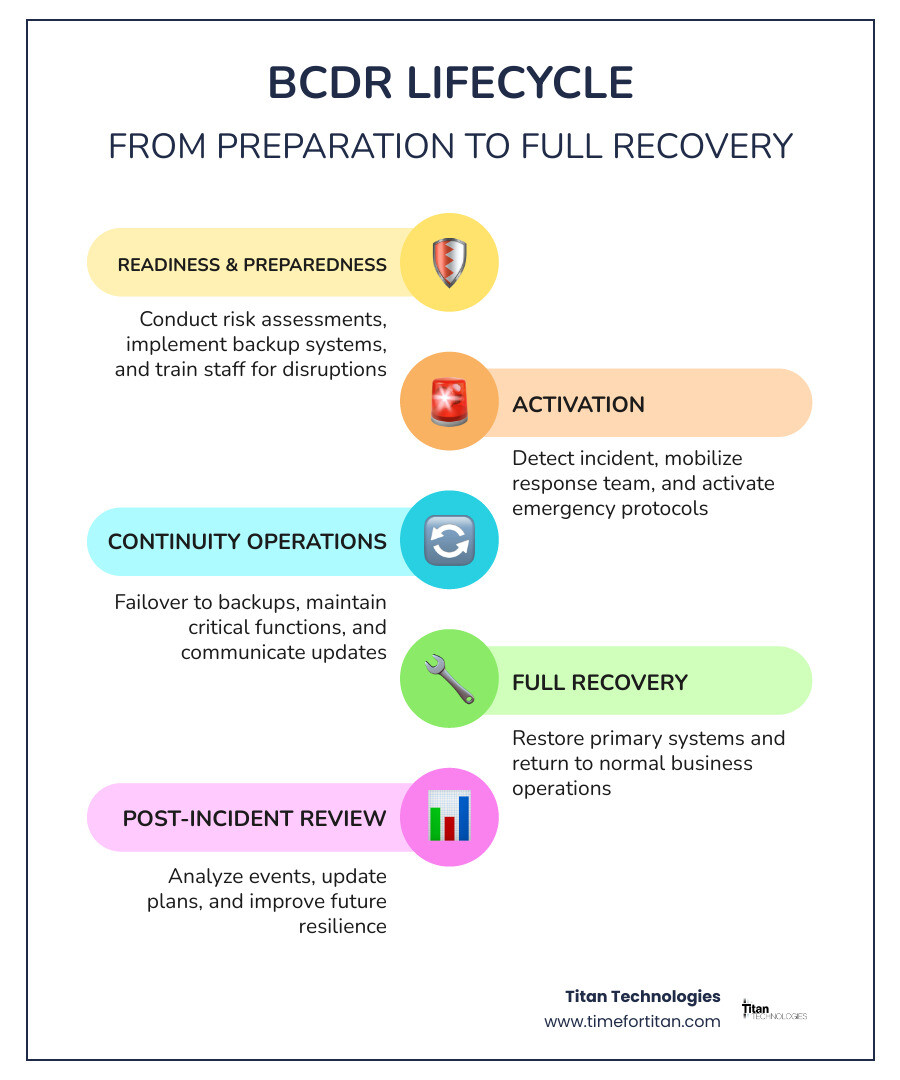
Key disaster recovery and continuity vocabulary:
Understanding Disaster Recovery and Continuity: Key Differences
While the terms are often used interchangeably in casual conversation, they are distinct disciplines. Think of it like a ship: Business Continuity is the sturdy hull and the navigation system that keeps you on course during a storm, while Disaster Recovery is the specialized repair crew that jumps in to fix the engines if they take on water.
| Feature | Business Continuity (BC) | Disaster Recovery (DR) |
|---|---|---|
| Primary Goal | Maintain operations during a crisis | Restore systems and data after a crisis |
| Focus | Holistic: People, processes, and partners | Technical: IT infrastructure and data |
| Timing | Proactive (starts before and during) | Reactive (starts after the event) |
| Scope | Entire organization | IT and telecommunications |
| Example | Relocating staff to a backup office | Restoring a server from a cloud backup |
According to BCMPedia’s definition of Business Continuity), the goal is to safeguard the interests of key stakeholders by protecting critical business functions against disruptions. On the other hand, BCMPedia defines Disaster Recovery as the ability to provide critical IT and telecommunications services after an incident.
One picks up where the other leaves off. You cannot have a truly resilient business in Newark or Princeton without both. If you want to dive deeper into the specifics of the BC side, you should show some love to Your Business Continuity Plan early and often.
The Proactive Nature of Business Continuity
Business Continuity is your organization’s “Plan B” for staying alive. It isn’t just about servers; it’s about people and processes. If your office in Edison is flooded, how do your employees answer customer calls? If a key supplier in Trenton goes offline, where do you get your raw materials?
A proactive BC strategy involves:
- Critical Function Identification: Determining which parts of your business must stay running to survive (e.g., payroll, customer support, sales).
- Risk Assessment: Identifying local threats, such as coastal storms in Red Bank or cyberattacks targeting New Brunswick medical practices.
- Workforce Management: Establishing remote work protocols or alternate facilities so your team can keep working.
- Data Protection Governance: Ensuring that your strategies meet legal requirements. This is where Data Protection Governance, Risk Management, and Compliance become vital, especially for regulated industries like healthcare and finance.
The Reactive Focus of IT Disaster Recovery
Disaster Recovery is the technical subset of your continuity efforts. When the “big one” hits—be it a massive ransomware infection or a hardware meltdown—DR is the set of procedures that gets your digital heart beating again.
Key reactive elements include:
- System Restoration: The step-by-step process of bringing servers and applications back online.
- Fail-over Strategies: Automatically switching to a secondary server or cloud instance when the primary one fails.
- Data Replication: Ensuring you have a “warm” copy of your data ready to go at a moment’s notice.
For a structured approach, we often look to the IT Disaster Recovery Plan guidance provided by Ready.gov, which emphasizes that these plans must be documented and tested to be effective.
Essential Components and Testing of a BCDR Plan
Building a disaster recovery and continuity plan isn’t a “one-and-done” task. It requires a structured approach to ensure no stone is left unturned. We start with a Business Impact Analysis (BIA). This is a fancy way of asking: “If this system goes down, how much money do we lose every hour, and how long can we survive without it?”
From the BIA, we derive two critical metrics:
- Recovery Time Objective (RTO): The maximum amount of time a system can be down before the business suffers irreparable harm.
- Recovery Point Objective (RPO): The maximum amount of data (measured in time) you can afford to lose. If you back up once a day, your RPO is 24 hours. For a law firm in Morristown, that might be too much!
To keep everything organized, you need a comprehensive Data Protection Plan that aligns with the NIST Contingency Planning Guide. These standards provide the framework for federal-grade security, which we adapt for our local SMB clients.
Developing Your Disaster Recovery and Continuity Strategy
When we sit down with a business in Woodbridge or Elizabeth, we follow a rigorous development process:
- Inventory Compilation: You can’t protect what you don’t know you have. We list every piece of hardware, every software license, and every data set.
- Backup Procedures: We move beyond old-school tapes and disks. Modern businesses need automated, encrypted backups.
- Offsite Storage: A backup sitting on a shelf in the same room as your server is just a paperweight if there’s a fire. We prioritize geographic redundancy.
- The Cloud Advantage: Utilizing a Cloud-Based Disaster Recovery Plan allows for near-instant failover. If your physical server in Matawan dies, we can “spin up” a virtual version in the cloud in minutes.
The Importance of Regular Testing and Maintenance
A plan that hasn’t been tested isn’t a plan—it’s a wish. We’ve seen businesses think they were safe, only to find out their backup files were corrupted when they actually needed them.
- Annual Drills: At a minimum, you should run a full-scale disaster simulation once a year.
- Plan Updates: Your business changes. You hire new people, adopt new software, and move offices. Your plan must evolve with you.
- Simulation Exercises: These “tabletop” exercises involve the whole team. We walk through a scenario—like a ransomware attack—and see if everyone knows their role.
For those looking for the gold standard in testing, the Guide to Test, Training, and Exercise Programs from NIST is an excellent resource. By being proactive, you can Prevent IT Disasters Before They Happen, saving your business thousands in potential downtime.
How BCDR Plans Work Together During a Crisis
When a disruption occurs, the clock starts ticking immediately. Here is how disaster recovery and continuity work in tandem during the first critical hours:
- Initial Impact (0-1 Hour): The incident is detected. The IT Disaster Recovery plan kicks in to assess the damage to the systems.
- Activation (1-4 Hours): If the disruption meets certain “trigger” criteria, the Business Continuity plan is activated. Critical staff are notified, and emergency communication channels are opened.
- The First 4 Hours: This is the “Golden Window.” For many businesses, this is when we switch operations to a remote DR site or a cloud failover environment.
- 24-Hour Mark: By now, customers, suppliers, and the press (if necessary) are notified. The focus shifts from “fixing the tech” to “keeping the customers happy.”
Many businesses ignore the reality of these situations until it’s too late. Don’t let your business be Business Interrupted: The IT Disaster You’re Probably Not Prepared For.
Roles and Responsibilities in Disaster Recovery and Continuity
Who does what when the power goes out in Trenton? Clear roles prevent the chaos that often follows a disaster.
- Mission Owners (Leadership): They hold ultimate accountability. They make the big calls, like whether to evacuate a building or pay a ransom (though we usually advise against the latter!).
- Continuity Coordinator: The “Project Manager” of the crisis. They ensure the BC plan is followed and that different departments are talking to each other.
- Incident Response Team: The technical experts. They are the ones actually performing the data restoration and system failovers.
- Stakeholders: This includes your employees, who need to know where to work, and your customers, who need to know their data is safe.
Properly defining these roles is a core part of our IT Risk Management Services. When everyone knows their job, the recovery time drops significantly.
Frequently Asked Questions about BCDR
What is the difference between data backup and disaster recovery?
Think of data backup as the “ingredients” and disaster recovery as the “recipe and the kitchen.” Backup is the act of copying your data to a safe place. Disaster recovery is the entire process of using those backups to rebuild your systems, reconfigure your network, and get your employees back to work. Having a backup without a DR plan is like having a bag of flour but no oven or recipe—you still aren’t getting any bread.
How often should a business test its disaster recovery plan?
We recommend a tiered testing schedule. You should verify your backups daily (automated). You should perform technical restoration tests quarterly. Finally, you should conduct a full-scale, “tabletop” business continuity drill annually. If you make major changes to your IT environment—like moving to a new office in Lakewood or switching to a new CRM—you should re-test immediately.
What is a reasonable Recovery Time Objective (RTO) for SMBs?
While “instant” is everyone’s favorite answer, it can be expensive. For most SMBs in Central New Jersey, a reasonable RTO is between 4 and 24 hours for critical systems. However, for highly regulated industries like healthcare or finance, you might need an RTO of less than an hour. We help you balance the cost of protection with the cost of downtime to find your “sweet spot.”
Conclusion
In an era where ransomware attacks happen every few seconds and extreme weather is becoming more common, disaster recovery and continuity planning is no longer optional—it’s a fundamental requirement for business survival. Whether you are a retail shop in Freehold or a medical facility in New Brunswick, the question isn’t if you will face a disruption, but when.
At Titan Technologies, we live and breathe this stuff so you don’t have to. We provide managed IT services and cybersecurity solutions specifically custom for businesses across Central New Jersey, including Edison, Elizabeth, Lakewood, Newark, Trenton, and beyond. Our professional team offers fast, reliable support with a 100% satisfaction guarantee. We don’t just “fix computers”; we build resilient organizations that can weather any storm.
Don’t wait for the lights to go out to realize you don’t have a flashlight. Let us help you build a fortress around your data and your operations. Explore our Business Disaster Recovery (BDR) Services today and sleep better tonight knowing your business is prepared for whatever tomorrow brings.