


For a CPA firm, technology has become so deeply connected to everyday operations that it is difficult to separate an IT problem from a business problem. When email stops working, employees cannot communicate with clients. When an accounting application becomes unavailable, work stops. When a security incident occurs, confidential client information may be at risk. And when any of these problems happen during tax season, what might normally be a frustrating technical issue can quickly become a serious business disruption.
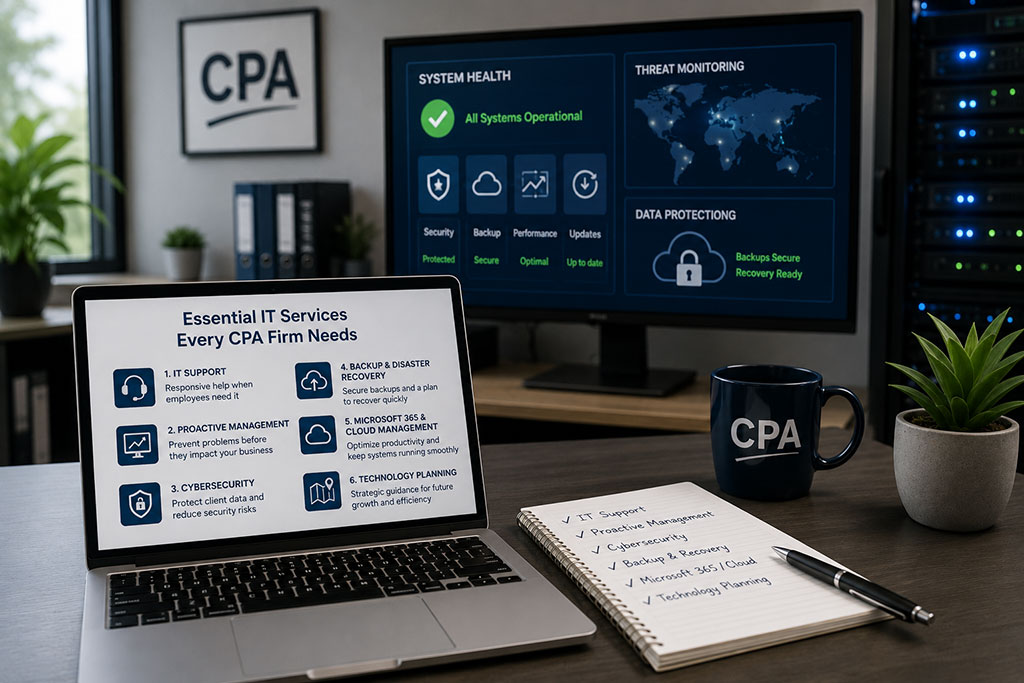
That is why CPA firms with 5–50 employees generally need much more than traditional computer support. A complete IT strategy should address at least six essential areas: responsive employee support, proactive technology management, cybersecurity, backup and disaster recovery, Microsoft 365 and cloud management, and long-term technology planning. When these six areas work together, the goal is not simply to keep computers running; it is to create a secure and reliable technology environment that allows accountants to work efficiently, protects sensitive client information, and gives firm leadership greater confidence about the technology supporting the business.
The distinction matters because many CPA firms already have someone they can call when something breaks. What they may not have is someone taking responsibility for what happens before something breaks.
1. CPA Firms Need IT Support That Understands the Business Behind the Problem
The most familiar IT service is technical support, and it remains an important part of any managed IT relationship. Employees need someone to contact when they cannot access an application, their computer is behaving unexpectedly, a printer stops working, Microsoft 365 is causing problems, or another technology issue prevents them from doing their jobs.
For a CPA firm, however, good technical support requires more than the ability to troubleshoot a computer. The IT provider needs to understand that the urgency of a problem often depends on what is happening inside the business.
Consider an accountant who suddenly loses access to a critical application. During a relatively quiet period, the disruption may be inconvenient but manageable. If the same problem occurs while the employee is trying to complete work ahead of a filing deadline, the business consequences can be considerably greater. Other employees may become involved, client work can be delayed, and a relatively small technical issue can consume hours of productive time.
This is why the best IT support relationships are built around business context rather than tickets alone. A provider should respond promptly, communicate clearly, understand which systems are most important to the firm, and look for the underlying causes of recurring problems instead of repeatedly applying temporary fixes.
Ultimately, the objective of support should not be to close more tickets. It should be to help the firm experience fewer preventable technology problems in the first place.
2. CPA Firms Need Proactive Technology Management, Not Just Reactive Repairs
This leads to the second essential service: proactive technology management.
Many technology problems provide warning signs before they become emergencies. Computers begin running slowly, storage capacity decreases, software falls behind on updates, hardware reaches the end of its useful life, or small recurring problems begin appearing across the environment. If nobody is actively monitoring those conditions, they can continue until something finally fails.
A reactive IT model waits for that failure. An employee notices the problem, contacts IT, and someone begins investigating.
A proactive managed IT model works differently. Systems are monitored, updates are managed, devices are maintained, risks are identified, and potential problems are addressed before they have an opportunity to significantly disrupt the business.
For an accounting firm, the economic impact of that difference can become substantial.
Imagine a CPA firm with 20 employees that loses access to an important system for two hours. Even before considering missed client deadlines, partner involvement, or the cost of repairing the underlying problem, the firm has potentially lost 40 hours of employee productivity. During a critical filing period, the business impact could be considerably greater.
That is why proactive IT management should focus on making the firm’s technology environment more predictable. Technology problems will never disappear completely, but a well-managed environment should reduce the number of surprises and prevent avoidable failures from becoming business emergencies.
3. CPA Firms Need Cybersecurity That Reflects the Value of Their Client Data
Cybersecurity is no longer a separate technology project that CPA firms can treat as an optional upgrade. It is a fundamental part of operating a business that handles confidential financial information.
Accounting firms may possess tax records, financial statements, payroll information, personally identifiable information, banking details, and confidential business documents. The value and sensitivity of that information means the firm’s cybersecurity strategy needs to extend well beyond installing antivirus software on employee computers.
A modern security strategy works in layers.
Employee identities need to be protected so that a stolen password does not automatically give an attacker access to the firm’s systems. Multi-factor authentication can create another barrier between stolen credentials and sensitive information, while appropriate permissions can help ensure employees only have access to the information required for their roles.
Computers and other devices need modern endpoint protection and ongoing monitoring. Email requires additional attention because phishing and credential theft often begin with a message designed to convince an employee to click a link, open a file, or provide information. Employees themselves also need security awareness because even sophisticated security technology cannot eliminate every human decision from the equation.
The important question for firm leadership is therefore not simply, “Do we have cybersecurity?”
A more useful question is, “If one of our employees’ credentials were compromised tomorrow, what additional protections would stand between that account and our clients’ information?”
The answer provides a much clearer indication of whether the firm has a layered security strategy or is relying too heavily on one or two individual tools.
4. CPA Firms Need a Recovery Plan, Not Merely a Backup
Backups are another area where the difference between having technology and having a strategy becomes important.
Most firms understand that important information should be backed up. The more difficult questions are what happens when that backup actually needs to be used, how much information could be lost, which systems would be restored first, and how long employees could realistically be unable to work.
That is the difference between backup and business recovery.
A strong recovery strategy begins by considering the business consequences of an outage. If a critical system disappeared this afternoon, how long could the firm continue operating? If ransomware affected important information, would the backup also be affected? If an employee accidentally deleted important files, how quickly could those files be restored? If a major outage occurred during tax season, who would make decisions about which systems should be recovered first?
One commonly used approach is the 3-2-1 backup framework, which calls for maintaining three copies of important information, using two different storage methods, with at least one copy separated from the primary environment.
The framework is useful, but the most important part of any backup strategy is knowing that recovery actually works.
A backup that has never been tested can create a dangerous sense of confidence. CPA firms should know not only that information is being copied somewhere, but that it can be restored within a timeframe the business can tolerate.
5. CPA Firms Need Microsoft 365 and Cloud Services to Be Actively Managed
The technology environment of a modern CPA firm no longer exists entirely inside the office.
Employees may use Microsoft 365 for email, documents, collaboration, identity, and cloud storage while simultaneously relying on specialized tax, accounting, payroll, and document-management applications. Some employees may work remotely, partners may need access while traveling, and seasonal employees may require access for only part of the year.
That flexibility creates enormous benefits, but it also creates another area that requires active management.
Simply purchasing Microsoft 365 licenses does not mean the environment is secure or properly configured. Employee identities need to be protected, permissions need to be managed, licenses should be reviewed, security settings need attention, and there should be a consistent process for adding employees when they join the firm and removing access when they leave.
The same principle applies to other cloud applications.
The goal should be to make information readily available to the people who legitimately need it while making unauthorized access significantly more difficult. When cloud services are managed as part of the overall IT strategy rather than as individual applications, CPA firms can gain the productivity benefits of cloud technology without unnecessarily increasing risk.
6. CPA Firms Need a Technology Plan for the Next 12–24 Months
The final component of a complete IT strategy is one that employees may rarely see but firm leadership should expect: strategic technology planning.
Technology decisions have financial consequences, and waiting until something breaks often turns a manageable investment into an unexpected expense. Computers eventually need to be replaced, software requirements change, cybersecurity protections need to evolve, and growing firms introduce new employees, applications, and technology demands.
A strong IT partner should help leadership anticipate those changes rather than simply react to them.
For example, a CPA firm should have some visibility into which computers are likely to need replacement during the next 12–24 months, what cybersecurity improvements should be budgeted for, whether existing applications continue to meet the firm’s needs, and how technology requirements might change if the firm adds employees, acquires another practice, expands remote work, or opens another location.
For accounting firms, there is another important consideration: timing.
A major system migration might make perfect sense strategically, but implementing it immediately before the firm’s busiest period could introduce unnecessary risk. Hardware replacements, cloud migrations, security projects, and other significant changes should therefore be planned with the firm’s business calendar in mind.
This is where an IT provider begins to become a strategic technology partner rather than simply a technical support company.
Technology strategy should support the firm’s business strategy, not compete with it.
What Does This Look Like for a Typical CPA Firm?
Consider a Central New Jersey CPA firm with 25 employees.
At first glance, the firm’s technology may appear to be working reasonably well. Everyone has a computer, email works, employees can access their accounting applications, backups appear to be running, and there is someone to call when a problem occurs.
But those facts alone do not tell leadership whether the firm’s technology is being properly managed.
A better evaluation begins with deeper questions.
Who is monitoring the environment when employees are not experiencing problems? Who is making sure computers receive security updates? How are employee identities protected? When was the firm’s recovery process last tested? What would happen if the primary file system became unavailable tomorrow morning? Which computers will need replacement next year? Who is reviewing Microsoft 365 security settings? What cybersecurity improvements should the firm budget for over the next 12 months?
If nobody has clear answers to those questions, the firm may have IT support without actually having an IT strategy.
A complete managed IT relationship connects those responsibilities. Support, monitoring, cybersecurity, recovery, cloud management, and strategic planning become parts of one system designed around the needs of the business.
How Much Should a CPA Firm Expect to Spend on Managed IT Services?
For a CPA firm with 5–50 employees, a useful budgeting range for comprehensive managed IT services can be approximately $150–$300 per user per month, although actual pricing depends on the firm’s technology environment, cybersecurity requirements, number of devices, applications, support expectations, and services included.
Using that range, a CPA firm with 10 employees might budget approximately $1,500–$3,000 per month, while a 25-person firm might fall around $3,750–$7,500 per month. At 50 employees, the same broad framework produces a range of approximately $7,500–$15,000 per month.
Those numbers should not be interpreted as universal pricing because managed IT proposals can include very different services.
That distinction is important when firms compare providers. A lower monthly price may look attractive until leadership discovers that important cybersecurity services, backup management, strategic planning, or other protections are not included.
The better comparison is therefore not simply, “Which provider charges less?”
It is, “What responsibility is this provider actually taking for our technology, security, and business continuity?”
From Reactive IT Support to a Managed Technology Strategy
Consider a growing CPA firm that has traditionally relied on reactive IT support. When something goes wrong, the firm calls its technology provider and eventually gets the problem resolved. From the outside, the arrangement appears to work.
As the firm grows, however, leadership begins noticing gaps. Recurring issues consume employee time. Nobody is completely certain when aging computers should be replaced. Cybersecurity has evolved through a series of individual products rather than a coordinated strategy. Backups exist, but leadership cannot confidently explain the recovery process. Technology decisions are made when they become urgent rather than being planned months in advance.
Moving to a managed approach changes the conversation.
Instead of focusing almost entirely on today’s technical problems, the firm begins considering what could interrupt the business tomorrow and what technology will be required next year. Systems can be monitored proactively, cybersecurity can be managed as a layered strategy, recovery can be tested, and technology investments can be planned around the firm’s priorities and busiest periods.
That shift — from repairing technology to managing technology — is where much of the value of managed IT comes from.
For Titan, this is also where a real CPA client story would substantially strengthen the article. A published version should ideally include an actual scenario describing the size of the firm, the challenge it faced, the changes Titan implemented, and measurable outcomes such as fewer recurring issues, faster response, security improvements, or reduced downtime.
How Can You Tell Whether Your CPA Firm Has the IT Services It Actually Needs?
Firm leaders do not need to become technology experts to answer this question.
Instead, consider whether you can confidently explain how your firm handles six responsibilities.
You should know what happens when an employee needs technical assistance, who is proactively monitoring and maintaining your systems, how employee identities and sensitive client information are protected, how quickly the business could recover from a serious technology failure, who is responsible for managing Microsoft 365 and other cloud services, and what technology investments the firm expects to make over the next 12–24 months.
If several of those answers are unclear, the issue may not be that your firm lacks technology.
The issue may be that nobody is taking responsibility for bringing all of that technology together into a coherent strategy.
Why CPA Firms Work With Titan
Titan’s role is not simply to be the company a CPA firm calls when something breaks. The larger objective is to help accounting firms build technology environments that are secure, reliable, predictable, and aligned with the way their businesses actually operate.
For CPA firms with 5–50 employees, that means looking at the entire environment rather than individual technical problems. Employee productivity matters. Cybersecurity matters. Recovery matters. Cloud management matters. Future technology investments matter. And during critical business periods such as tax season, all of those areas need to work together.
The ideal outcome is straightforward: accountants should be able to concentrate on accounting, partners should be able to concentrate on clients and the growth of the firm, and the technology supporting both should operate quietly and reliably in the background.
Before publication, Titan should strengthen this section with its actual years of experience, number of CPA clients supported, relevant certifications and technology partnerships, response-time metrics, and a measurable CPA client success story. Those specifics turn positioning statements into evidence and make the content substantially more useful for both prospective clients and AI search.
Final Takeaway: CPA Firms Need an IT Strategy, Not Just an IT Company
The question “What IT services does a CPA firm actually need?” has a relatively simple answer, but implementing that answer requires a coordinated strategy.
A modern CPA firm needs six core capabilities: responsive employee support, proactive technology management, layered cybersecurity, reliable backup and recovery, active management of Microsoft 365 and cloud services, and strategic technology planning.
What matters most is not whether the firm can check each service off a list. It is whether those services work together.
When they do, technology becomes more predictable, employees experience fewer interruptions, security receives continuous attention, leadership has greater visibility into future investments, and the firm is better prepared for the periods when reliability matters most.
So the most useful question for CPA firm leadership may not be:
“Do we have IT support?”
It may be:
“Do we have someone taking responsibility for making sure our technology is secure, reliable, and ready for what our firm needs next?”